
Last updated October 30, 2026
 Wrought iron
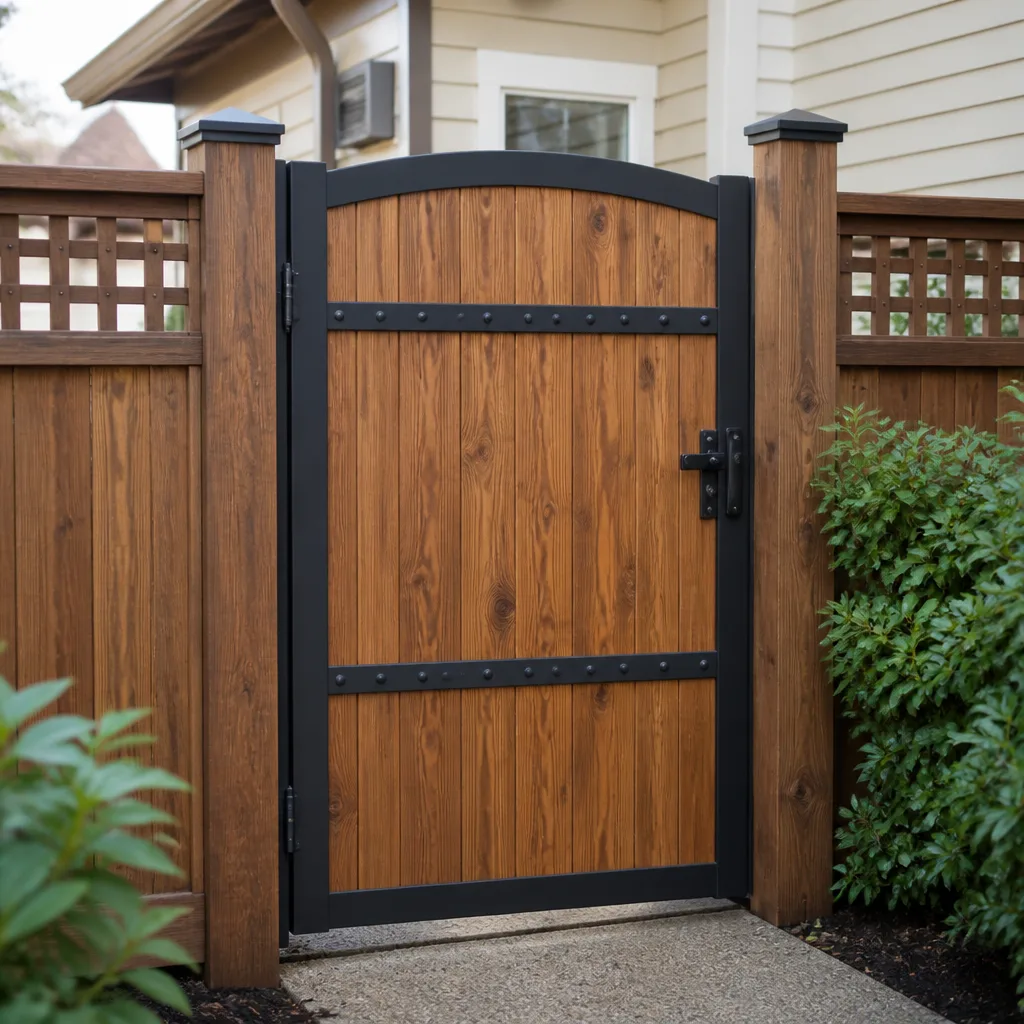 Wood & steel frame
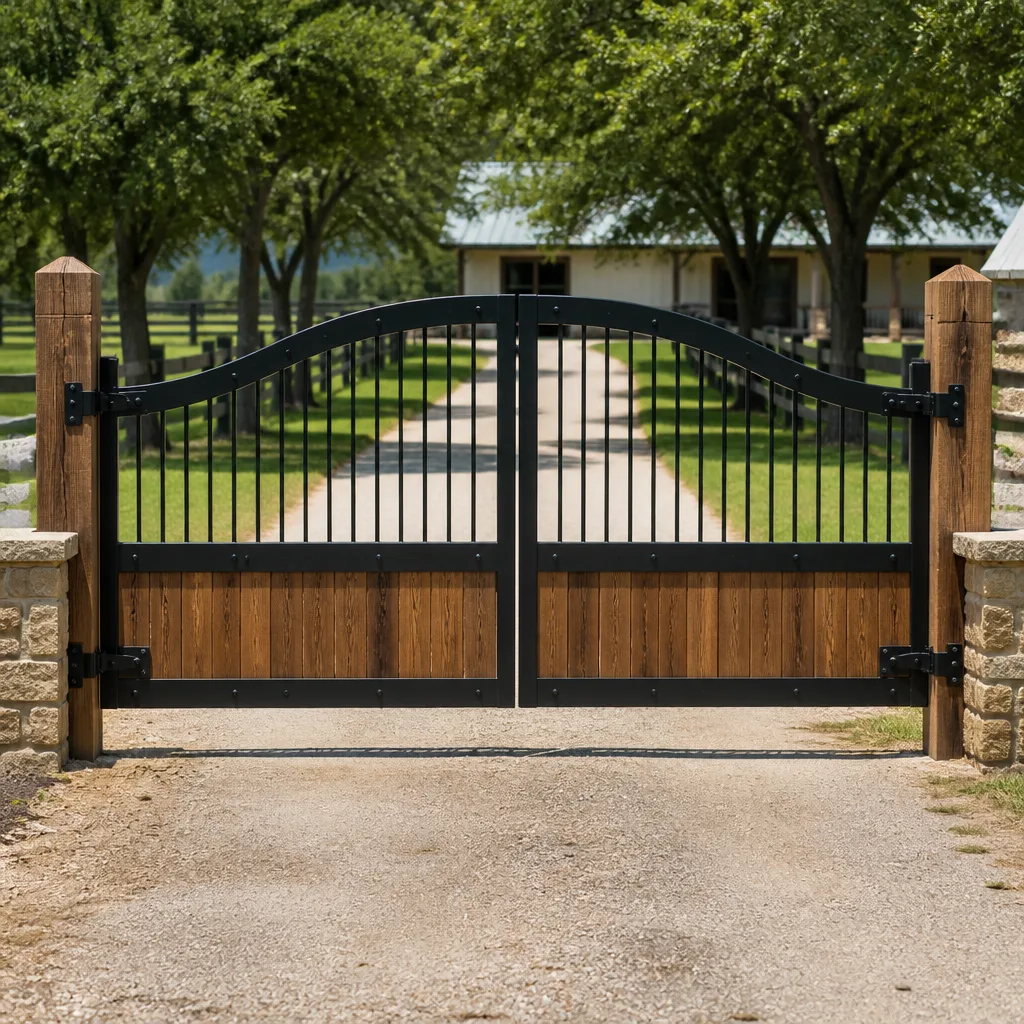 Farm & ranch
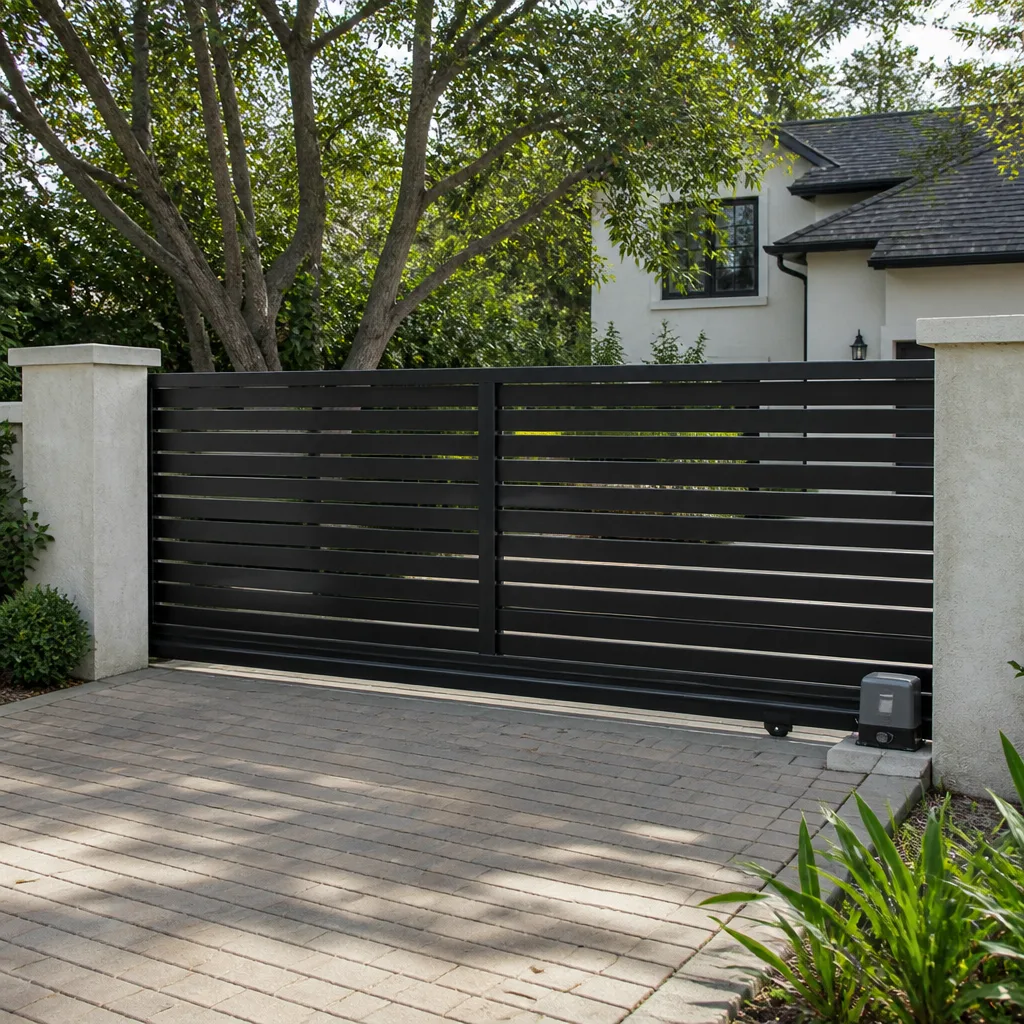 Sliding driveway gates
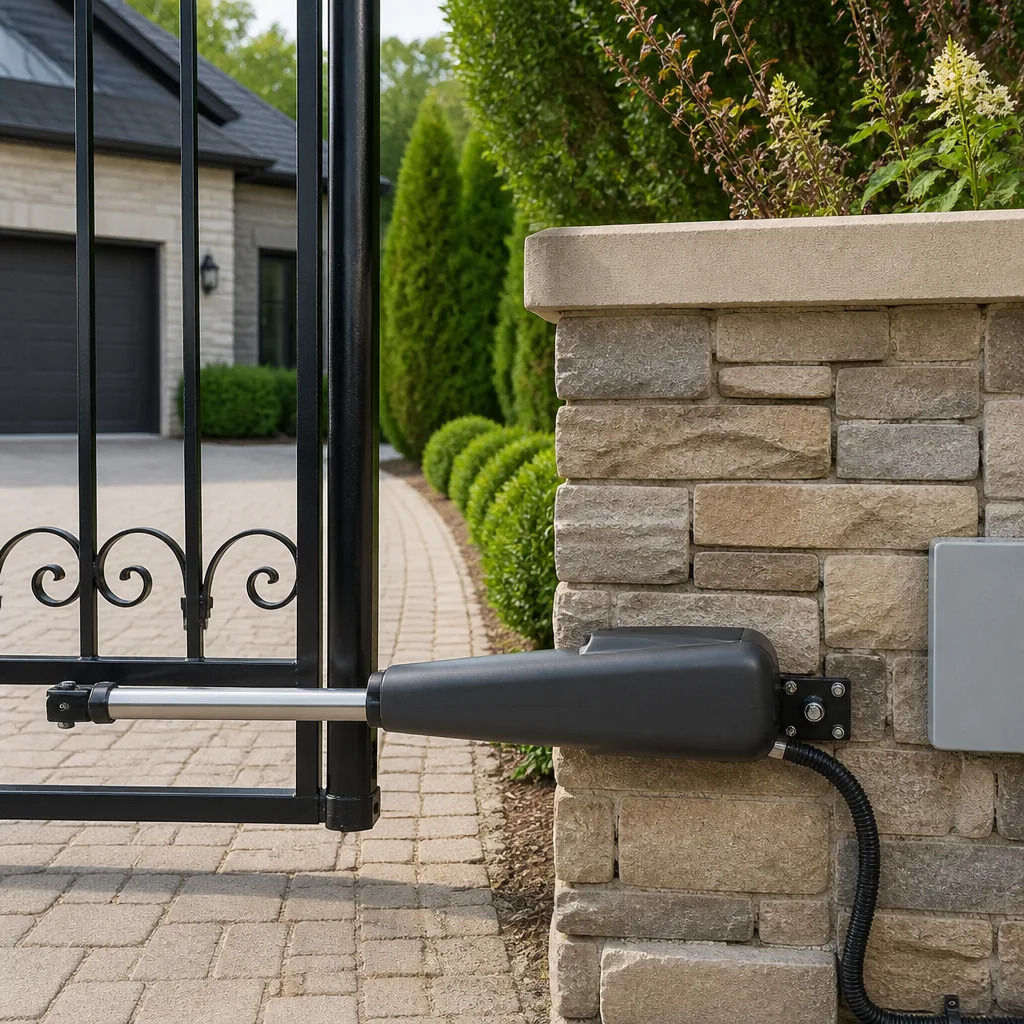 LiftMaster operators
Free on-site gate assessment - hinges, posts, and your LiftMaster or Nice gate operator checked before anything is quoted
The assessment is free and the quote is the invoice.
Get your free estimateGate Repair Emergency Preparedness Guide for Daytona Beach Homes
Most Daytona Beach homeowners think about gate failure the wrong way. They worry about the gate not opening when they’re late for work. But the real emergencies are different: a gate stuck open at 2 a.m. with no way to secure the property, or a gate stuck closed when a hurricane evacuation order drops and the operator has no power. During Hurricane Matthew, residents across Daytona Beach reported exactly this: electric gates that wouldn’t budge because no one knew where the manual release was, or how to use it in the dark with rain coming sideways. This guide gives you the protocols for both scenarios, plus the documentation and preparation steps that turn a potential crisis into a five-minute fix. For professional help, see our Gate Repair services. If you own an automated gate in Daytona Beach, this is the page you’ll wish you’d read before the wind picks up.
Styles & brands we work with
Quick Answer
Gate emergencies in Daytona Beach break into two categories: a gate stuck open (a security emergency) and a gate stuck closed (a life-safety emergency during evacuation or fire access). Your preparedness plan needs three things: knowing where your manual release is and how to operate it, having interim security measures for an open gate, and keeping documentation like your operator model number and installer contact somewhere you can find in the dark. Most gates can be manually operated in under two minutes if you know the release mechanism for your specific brand.
Table of Contents
- The Two Types of Gate Emergencies (and Why Daytona Beach Is Different)
- How to Locate and Operate the Manual Release on Six Common Operators
- Gate Stuck Open: The Immediate Security Protocol
- Flooding and Powered Gates: Disconnection Without Electrical Hazard
- Storm Season Documentation: What to Photograph and Where to Store It
- Post-Storm Safety Checks Before Manual Operation
- Battery Backup and Why It Fails When You Need It Most
- Common Mistakes to Avoid
- When to Call a Professional
- Frequently Asked Questions
- The Bottom Line
The Two Types of Gate Emergencies (and Why Daytona Beach Is Different)
Every gate failure lands in one of two buckets, and the urgency is not the same. A gate stuck open means anyone can walk or drive onto your property. It’s a security problem. A gate stuck closed means you can’t leave, or emergency vehicles can’t get in. It’s a life-safety problem. Daytona Beach adds a third variable most inland cities never think about: storm surge and flooding. A gate that works fine on a Tuesday afternoon behaves differently when saltwater is climbing the track and the control board sits six inches above the driveway.
We’ve worked on gates across Daytona Beach long enough to see the failure patterns repeat. The operator that worked for nine years suddenly dies during a July thunderstorm. The chain that pulled a leaf gate smoothly for a decade binds halfway through its travel in August humidity. The keypad that worked fine until a three-day rain exposed a corroded wire connection. Understanding which emergency you’re dealing with determines your first move, and your first move should never be “call a friend who’s good with tools.”
Here’s the distinction that matters:
- Security emergency (gate stuck open): You can still leave. You can still call someone. But your property is exposed. This is when you need interim physical security measures and a plan to get the gate closed or blocked.
- Life-safety emergency (gate stuck closed): You cannot get a vehicle out. If a doctor’s appointment, a fire evacuation, or a hurricane order requires you to leave, a closed gate becomes a barrier, not a feature. This is a manual-release situation, immediately.
- Storm-compromised gate (either position, after weather): The gate moved during high winds or flooding and now sits in a position that isn’t right. Before anyone tries to operate it manually, there are structural and electrical checks to run in order.
The rest of this guide walks through each scenario with the exact steps Daytona Beach homeowners should take before, during, and after the emergency. For Gate Repair Maintenance Checklist for Daytona Beach Homeowners, see our detailed resource.
How to Locate and Operate the Manual Release on Six Common Operators
If you learn one thing from this guide, make it this: the manual release is the part of your gate system that disengages the operator from the gate leaf so a human can push or pull it open by hand. It exists on every automated gate system. It is not hidden on purpose. And most homeowners have never touched it. Here are brand-specific instructions for the operators we see most often on Daytona Beach residential properties.
Mighty Mule (MM360, MM371, MM571)
Look at the top of the operator arm where it connects to the gate bracket. There’s a small metal pin with a ring or pull handle on it. Pull that pin straight up. The arm will drop free from the gate bracket, and the gate can now be moved by hand. Some newer Mighty Mule models have a keyed release that requires a small key (usually stored on top of the control box or zip-tied to the arm). If yours has a key, turn it a quarter turn counterclockwise, then pull the pin.
Ghost Controls (AXDP, AXP1, TDS2)
Ghost Controls uses a “push-to-release” mechanism. Find the two metal prongs where the operator connects to the gate bracket. Squeeze them toward each other while pushing the arm upward. The arm pops off the bracket and the gate swings freely. To re-engage later, push the arm back down over the bracket until it clicks.
LiftMaster / Elite (residential swing and slide)
Most LiftMaster and Elite residential operators have a manual release handle on the side of the motor housing or a chain-driven carriage release. For slide gates, look for a T-handle or red knob near the motor. Pull it outward and rotate a quarter turn to disengage the drive gear. For swing arms, there’s typically a lever near the pivot point that unlocks the arm from the motor.
DoorKing (residential slide and swing)
DoorKing operators, even the residential models, are built like commercial equipment. On a DoorKing slide gate, there’s a metal cover on the side of the operator. Remove it with a screwdriver and you’ll see a release handle. Pull it toward you and the motor disengages from the chain. On swing models, the release is usually a red pull cord near the top of the housing. Pull firmly until you hear a click.
BFT and FAAC (where installed residentially)
Both brands use a keyed manual release on the operator housing. The key slot is visible on the front or side of the housing. Insert the key, turn it a half turn, and the operator disengages. If you’ve lost the key, a flathead screwdriver often works in a pinch, but order a replacement key from the manufacturer before you need it again.
Linear (residential swing arms)
Linear swing operators typically have a pull handle on the bottom of the arm where it meets the gate bracket. Pull the handle down and toward you. The arm separates from the bracket and the gate moves freely. Re-engaging is just pushing the arm back onto the bracket until it locks.
Action step: Walk out to your gate this week, identify your operator brand, and practice the manual release once. Do it in daylight, with no pressure. You’ll remember it when the power is out and the rain is coming down. If you don’t know your operator brand, look for the model plate on the housing and snap a photo of it. If the plate is faded or missing, Regent Gate Repair home technicians identify unmarked operators by sight on service calls across Daytona Beach regularly.
Gate Stuck Open: The Immediate Security Protocol
A gate that won’t close at 11 p.m. is a different problem than a gate that won’t close at 2 p.m. on a Saturday. Both are annoying. The 11 p.m. version is a security breach. Here’s the protocol, in order.
- Attempt a basic reset first. Many operator failures are trips from a power surge or a safety-edge false reading. Find your operator’s circuit breaker or unplug the transformer, wait 30 seconds, and restore power. This fixes somewhere between 20% and 30% of “dead” gates.
- Check the safety sensors. If the gate tries to close but reverses immediately, something is blocking the safety edge or photo-eye sensors. Look for debris, overgrown vegetation (common in Daytona Beach’s humid growing season), or a misaligned sensor knocked loose by a storm.
- If the gate won’t move at all and you can’t close it, block the opening physically. A vehicle parked across a driveway opening is the fastest deterrent. Not a permanent solution, but better than an open invitation. Chain and a padlock through the gate leaf and a fixed post is another option if you have the hardware on hand.
- Notify your monitoring company if you have one. Tell them the gate is open, the operator is down, and you’ll update them when it’s secured. If your security system has a separate driveway alarm, ask the monitoring company to treat any driveway-triggered event as high priority until the gate is fixed.
- Call for electric gate repair. Get a gate specialist on the schedule. In Daytona Beach, that means someone who works on your specific operator brand and can troubleshoot the control board rather than just replacing the whole unit.
One note from our experience: a gate that opens fine but won’t close is usually a sensor or safety-edge problem, not a motor problem. A gate that won’t open and won’t close from any input (remote, keypad, hardwired button) is usually a control board or transformer failure. If you’re in the second category, there’s a good chance the fix is replacing a board, not the whole operator. That’s a much faster repair and a much smaller invoice.
Flooding and Powered Gates: Disconnection Without Electrical Hazard
Daytona Beach has hundreds of flood-zone properties, and automated gates on those properties face a specific risk: water reaching the operator, the transformer, or the junction boxes. Here’s the critical safety point: do not touch a gate operator or its wiring if water is touching the unit or you’re standing in water. Gate operators run on low-voltage DC power from a transformer, but that transformer is plugged into a 120-volt AC outlet somewhere nearby, and water plus AC voltage is a lethal combination.
The correct sequence for flood-prone Daytona Beach properties:
- Before storm season, identify where your operator gets power. It’s typically a weatherproof outlet or a dedicated circuit. Know which breaker controls it and label that breaker “GATE.”
- If flooding is forecast, cut power to the gate at the breaker before water arrives. This eliminates the electrical hazard entirely. The gate will not operate automatically, but you’ll use the manual release if you need access.
- Never walk through standing water to reach a gate operator. If the gate is in a low spot and water has pooled around it, wait for the water to recede or call an electrician or gate specialist who can assess the situation safely.
- After flooding recedes, do not restore power to the gate without an inspection. Saltwater intrusion into connectors, control boards, and transformer housings causes corrosion that may not show immediate symptoms. A Daytona Beach gate specialist can check the wiring, dry out enclosures, and replace compromised components before you put power back on.
Saltwater is the variable many homeowners forget. A gate three blocks from the ocean in Daytona Beach gets salt spray on every metal surface, every connector, every circuit board. After any flooding event, that salt accelerates corrosion dramatically. The gate might work for two weeks after a flood, then fail because a connector corroded through. If floodwater touched your operator, get it inspected even if it seems fine.
Storm Season Documentation: What to Photograph and Where to Store It
The difference between a two-hour repair and a week of back-and-forth during a busy storm season often comes down to whether the homeowner can answer three questions: what brand is your operator, what model is it, and who installed it. Most can’t answer any of them. Here’s what to document now, while the sun is out and the gate works fine.
Photograph the operator nameplate. The nameplate shows the brand and model number, and it’s usually on the side or inside of the operator housing. If it’s faded, photograph it anyway. We’ve identified operators from partial nameplates and housing shape many times.
Photograph the control board. If you’re comfortable removing the operator cover (power off first), snap a photo of the control board. Board revisions change between production years, and a photo lets a gate specialist identify the exact replacement board before a truck rolls out. If you’re not comfortable removing the cover, don’t. A technician can do it on arrival.
Note the manual release mechanism. Write down, in your own words, where the release is and how it works on your specific operator. Store that note somewhere you can access it from your phone during a power outage. Screenshot it into a notes app. Print it and tape it inside the garage door.
Document battery backup status. If your operator has a battery backup system, know the age of the batteries. Most battery backups use sealed lead-acid batteries that last three to five years. Write the install date on the battery with a marker. If you don’t know whether your system has battery backup, check the model number or call us and we can tell you from the operator model.
Keep the installer’s contact info with the documentation. If the installer is still in business and responsive, great. If not, have a local gate repair company saved in your phone. Waiting until the emergency to search “gate repair near me” in Daytona Beach means you’ll be calling whoever paid for ads that week, not necessarily whoever can fix your specific brand.
If you’re not sure what you’re looking at, electric gate repair in Flagler Beach follows the same documentation protocol we recommend for Daytona Beach homeowners: photograph the nameplate, identify the manual release, and store everything somewhere accessible offline.
Post-Storm Safety Checks Before Manual Operation
A gate that survived a storm can still be dangerous to operate manually. Downed limbs can put weight on the track or hinges. The gate leaf itself may have shifted on its mount. Wiring may have pulled loose inside the operator housing. Run these checks in order before you try to push or pull the gate by hand.
- Visually inspect the gate from both sides. Look for bent leaves, broken pickets, sagging hinges, or anything that looks like it moved during the storm. If the gate leaf is visibly warped or hanging lower than normal, do not force it. Forcing a structurally compromised gate can tear hinge bolts out of the post.
- Check the track and wheels (slide gates). Debris in the track is the most common post-storm failure we see in Daytona Beach. Sand, leaves, small branches, and bits of shingle all end up in the V-track. Clear obvious debris, then spin the wheels by hand or push the gate a few inches in each direction. Resistance means something is in the track or a wheel is damaged.
- Check the operator wiring visually (power off). Look for wires that pulled loose from terminal blocks. If you see exposed copper or loose connections, do not restore power. Call a gate specialist.
- Disengage the operator with the manual release. Now push or pull the gate slowly through its full travel. Listen for grinding, feel for binding. If it moves smoothly and evenly, the gate is probably safe to operate manually until power and operator are restored.
- If anything feels wrong, stop. A gate that binds, catches, or requires force to move has a problem that manual operation will make worse. Extra force applied to a stressed gate can cause sudden failure, and a gate leaf falling is a crushing hazard.
After you’ve confirmed the gate moves freely by hand, you can leave it disengaged and use it manually while you wait for repair. Just remember: a manually operated gate does not close automatically behind you, and it can swing or slide back if there’s any grade to your driveway. Prop it or chain it in the desired position.
Battery Backup and Why It Fails When You Need It Most
Battery backup systems are sold as the answer to power outages. On paper, they work: during a blackout, the gate keeps operating on battery power for a number of open/close cycles, then recharges when grid power returns. In practice, battery backup fails during the exact moment of highest need for a simple reason: no one replaces the batteries until they’re already dead.
Here’s the failure cycle we see repeatedly on Daytona Beach properties. The battery backup is installed. Three or four years go by. The batteries degrade slowly, losing capacity. The homeowner never notices because grid power has been fine. Then a hurricane knocks out power, and the “backup” system has enough charge for one or two open/close cycles, after which the gate is dead. The homeowner is now in the stuck-open or stuck-closed scenario described earlier, with no warning.
If your system has battery backup:
- Know the battery age. Mark the install date with a permanent marker.
- Replace sealed lead-acid batteries every three to four years, regardless of how they seem to be performing.
- Test the backup system monthly by shutting off the gate’s circuit breaker and trying a full open/close cycle.
- If the gate moves slowly on battery power or only completes one cycle, the batteries are fading.
If your system doesn’t have battery backup and you live in a Daytona Beach neighborhood where power outages last more than a few hours, consider adding one. The manual release is always there as a fallback, but during heavy rain, nobody wants to stand outside wrestling with a gate arm. A fresh battery backup solves that.
For homeowners slightly outside Daytona Beach, the same principles apply. Gate repair in Flagler Beach addresses battery backup testing and replacement for coastal properties, where salt air accelerates battery housing corrosion even faster than inland.
Common Mistakes to Avoid
- Forcing a gate that won’t move. A gate that binds and then gets forced through its travel is how hinge bolts shear and leaf frames bend. If it doesn’t move easily by hand after disengaging, stop and inspect. Forcing it turns a $200 repair into a $2,000 gate leaf replacement.
- Restoring power to a flooded operator without inspection. Water inside an operator housing plus energized circuits equals a short that can fry the control board instantly. Worse, it can create a shock hazard. If water touched the operator, have it inspected before power is restored.
- Losing the manual release key. Several brands we work on, including DoorKing, BFT, and some Mighty Mule models, use a keyed release. That key goes missing, and suddenly your manual fallback is gone. Order a duplicate key and store it with your storm documentation.
- Calling a garage-door company for a gate problem. We see this in Daytona Beach more than you’d think. Garage-door technicians work on overhead doors. Gate operators are a different category of equipment with different control systems, different safety requirements, and different failure modes. The result is often a misdiagnosis and a replaced part that wasn’t the problem.
- Ignoring early warning signs. A gate that moves slower than usual, hesitates at the open position, or buzzes without moving is telling you something. Every one of those symptoms has a specific cause, and none of them resolve on their own. The gate fails when you’re least ready for it because you ignored the warnings when it was convenient to ignore them.
- Not practicing the manual release until the emergency. Manual releases are simple once you know where they are and how they work. In the dark, with rain coming down and an evacuation order on your phone, “simple” becomes “impossible” if you’ve never done it before. Practice it now. Once is enough.
- Assuming the gate will be fine because it made it through the last storm. Every storm stresses hinges, motors, control boards, and wiring differently. A gate that survived Matthew may fail during the next one because corrosion and wear accumulated in the years between. Past performance is not future protection.
When to Call a Professional
Some gate problems are diagnostic puzzles that benefit from training and brand-specific experience. Call a gate specialist if: the gate trips the breaker repeatedly, the control board shows error codes you don’t understand, the operator hums but the gate doesn’t move, you smell burning near the operator, the gate has been through flooding and you haven’t had it inspected, or you’ve tried the basic reset and the gate still won’t respond. These symptoms indicate electrical or mechanical failures that require part-level diagnosis, and guessing wrong means paying for parts you don’t need. Regent Gate Repair offers free estimates in Daytona Beach. Call (855) 927-1091 and we’ll diagnose the specific failure on your specific operator brand before quoting the repair.
Frequently Asked Questions
Emergency gate repair in Daytona Beach typically ranges from $150 to $450 for common failures like safety sensor replacement, control board swapping, or limit switch adjustments. More involved repairs like motor replacement or hinge work run higher, and the total depends on your operator brand and the parts needed. The price is quoted and agreed before any work starts, so you’re never surprised by the invoice. Call (855) 927-1091 for an exact quote on your specific system, and the estimate is free.
Yes, in most cases we can dispatch a Daytona Beach gate technician the same day, especially for security emergencies where a gate is stuck open or a life-safety situation where a gate is stuck closed. Parts availability depends on your operator brand and what failed, but most common failures are repaired on the first visit. Call (855) 927-1091 early in the day for the best chance at same-day service.
A full gate installation includes the gate leaf or leaves, the operator (motor and control board), safety edges and photo-eye sensors, power wiring from your electrical panel or a nearby outlet, and the mounting hardware from post to panel. The price varies based on gate size, operator brand, and site conditions. We quote the complete scope before starting, and you’ll see every line item. For new construction or full replacement in the Daytona Beach area, gate installation in Flagler Beach follows the same quoting process: measure, written quote, installation.
Yes, electric gate repair includes the full electrical scope: power runs, transformer installation, control board wiring, loop detectors, safety edges, and photo-eye sensors. We work on residential systems using Mighty Mule, Ghost Controls, Elite, and commercial-grade systems using DoorKing, FAAC, and BFT. The safety edges and sensors are not optional extras; they’re part of the system and they’re checked on every service call.
First, try a quick power reset by turning the gate’s circuit breaker off for 30 seconds and back on. If the gate still won’t close, block the driveway opening with a vehicle, chain the gate leaf closed if possible, and call a gate repair specialist. Do not attempt to force the gate closed by hand if the operator is still engaged; use the manual release first. Then call (855) 927-1091 for an in-person diagnosis.
Yes, every automated gate has a manual release that disengages the operator so the gate can be pushed or pulled by hand. The release mechanism differs by brand: Mighty Mule uses a pull pin, Ghost Controls uses a push-to-release bracket, DoorKing uses a pull handle or red cord, and Linear uses a pull handle on the arm. The trick is knowing where yours is before the power goes out. If you’re not sure, test it this week or call us and we can walk you through it over the phone.
The Bottom Line
Gate emergencies in Daytona Beach are predictable problems with simple preparation. Know your operator brand and model. Know where the manual release is and how to use it. Know what to do if the gate is stuck open (block it, call for repair) versus stuck closed (manual release, evacuate if needed). Document everything before storm season and store it somewhere you can reach in the dark. And when a repair requires a specialist, call one who works on gates exclusively, not a generalist who stops by between garage-door calls. The difference is a technician who can name the failure before the truck arrives. If you need that, call (855) 927-1091 for a free estimate.
Written by the team at Regent Gate Repair, serving Daytona Beach since 2013. Explore our more guides & resources.
See the difference
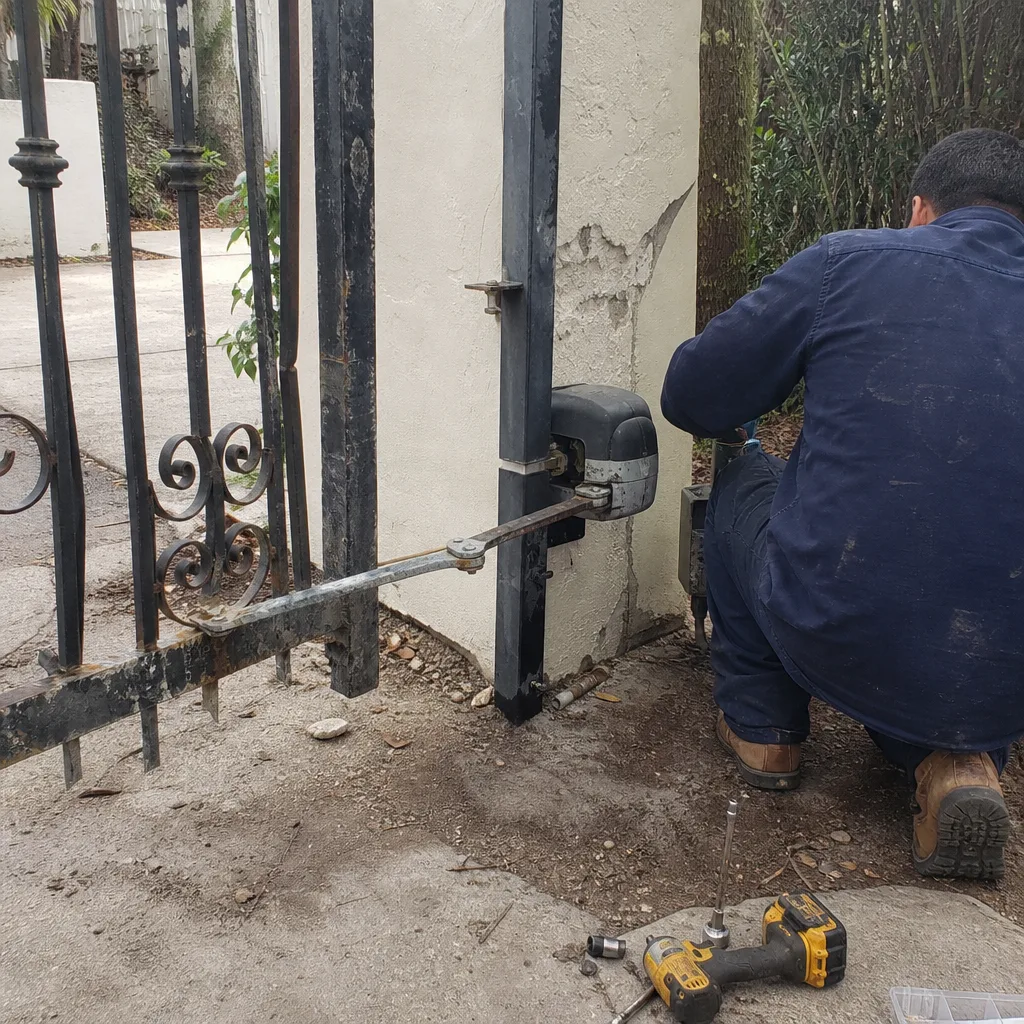 Before
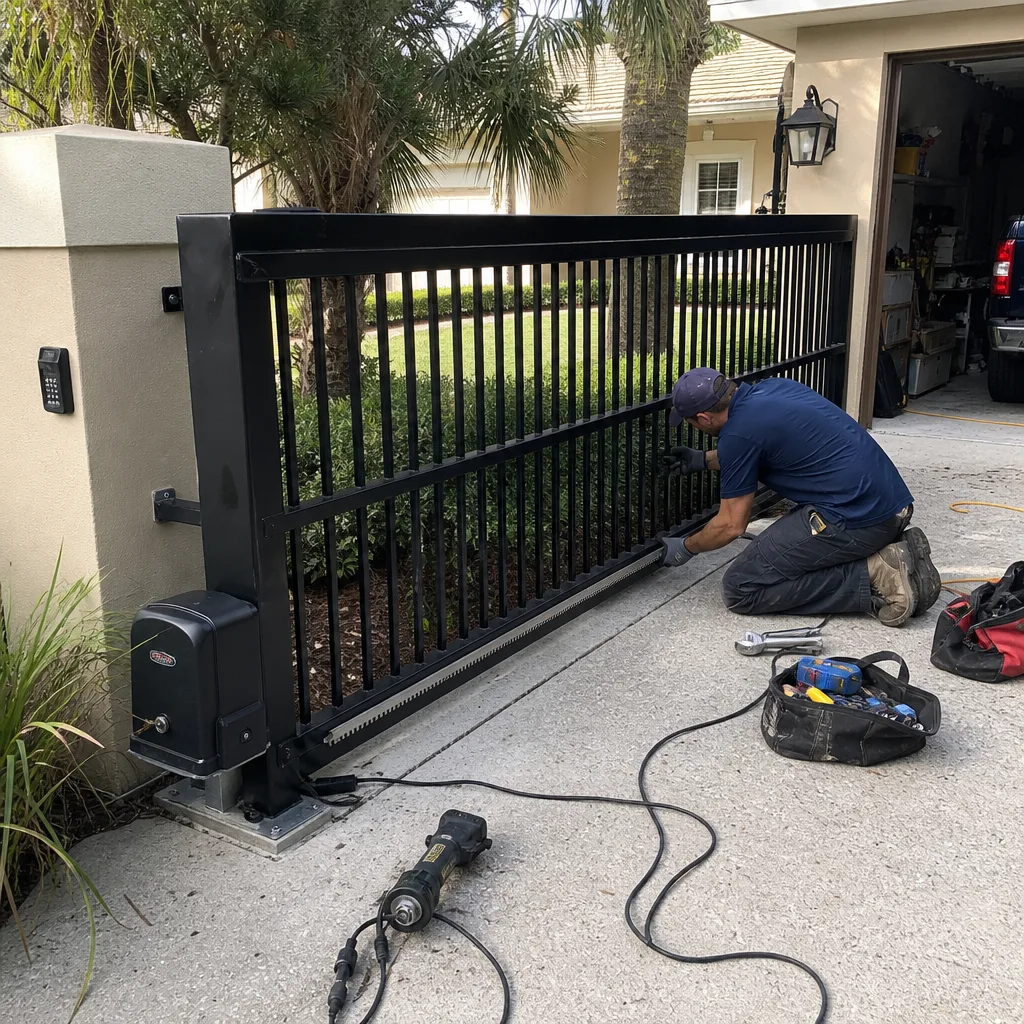 After
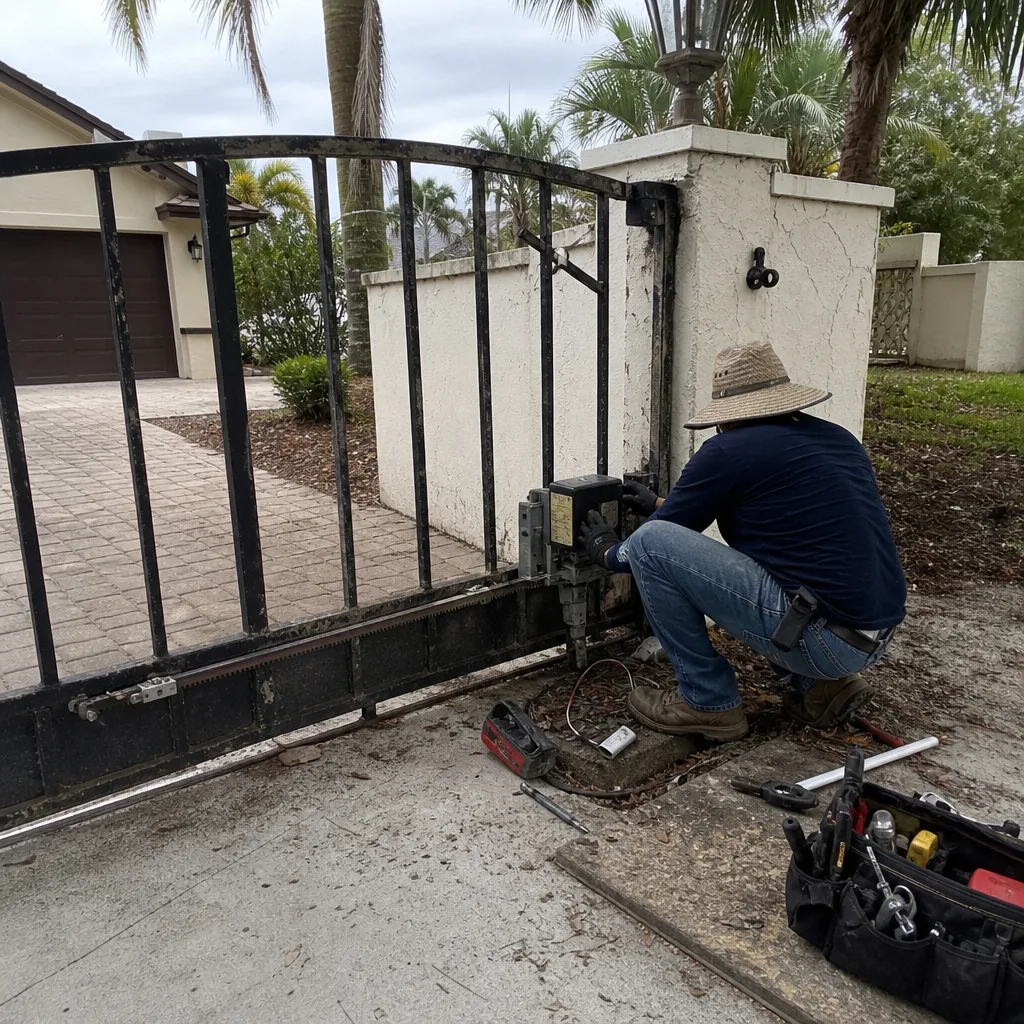 Before
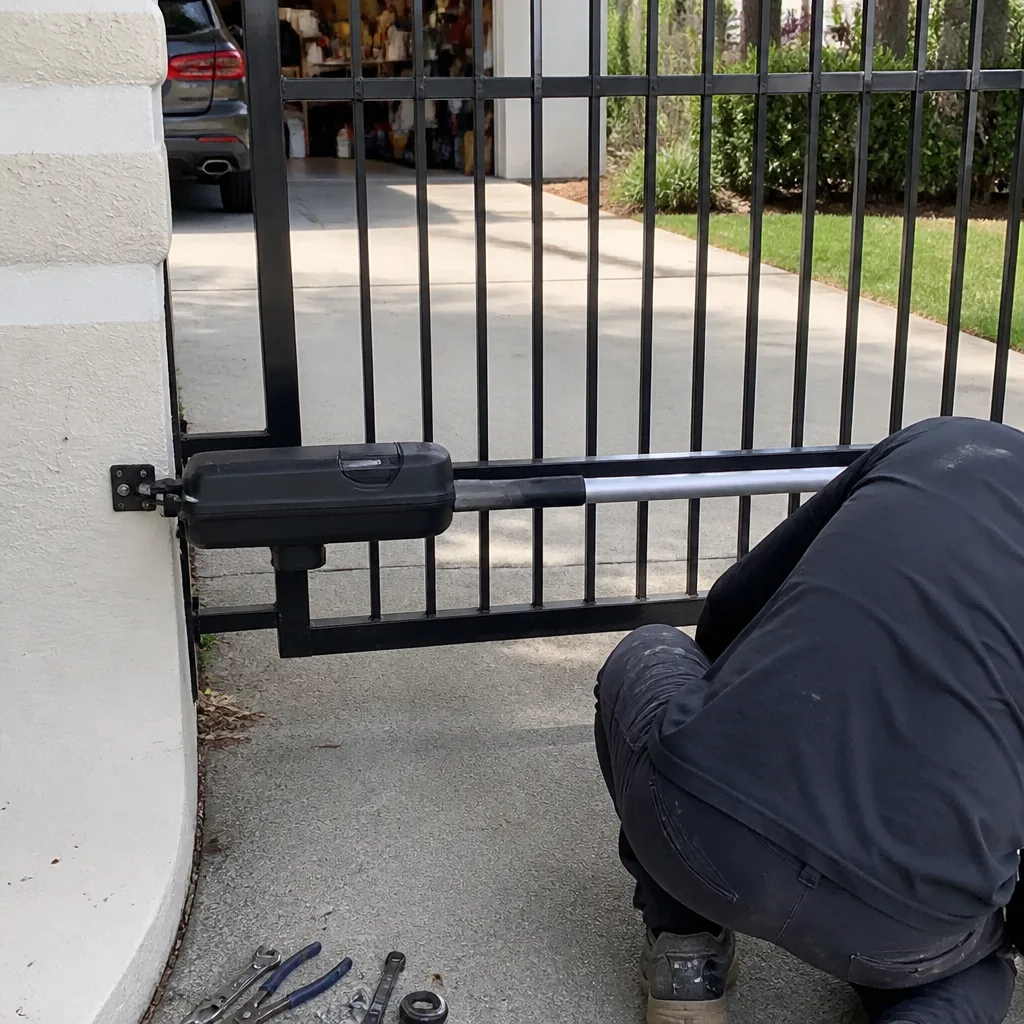 After
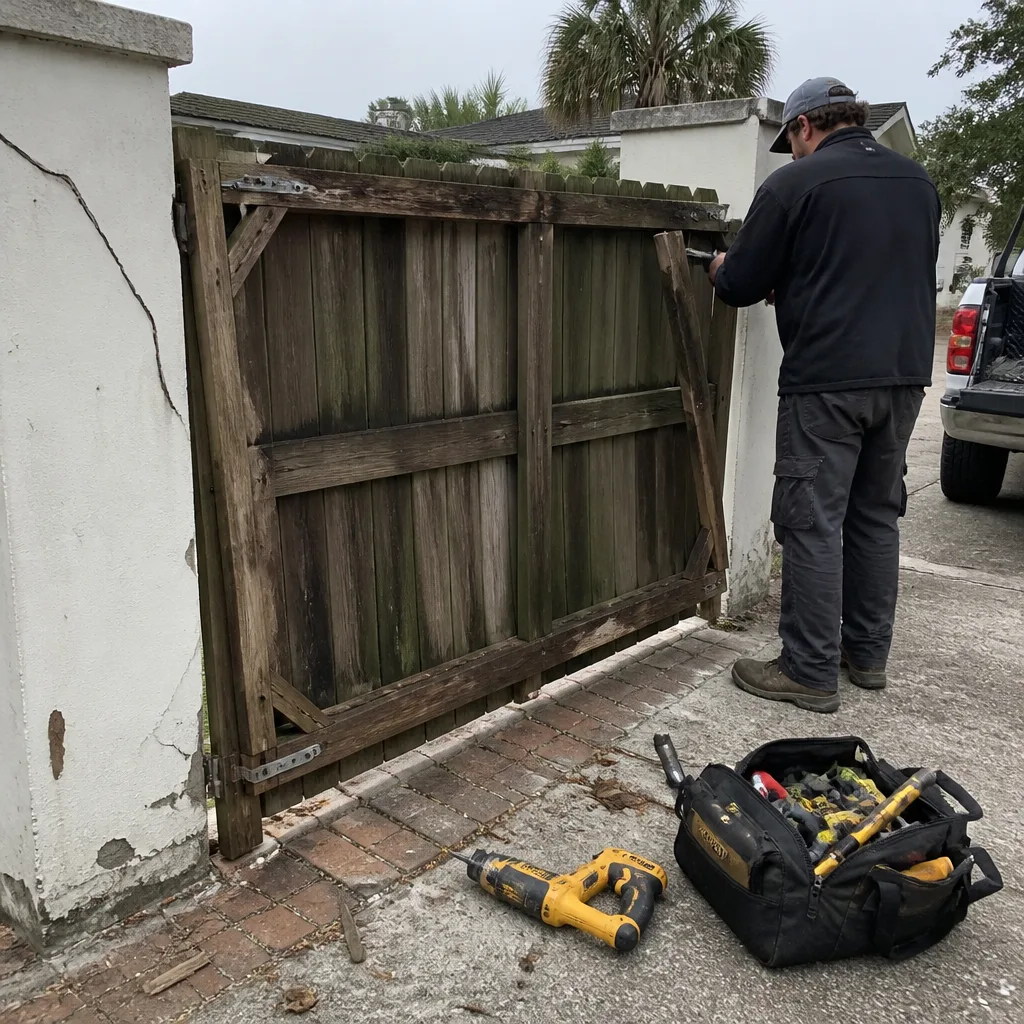 Before
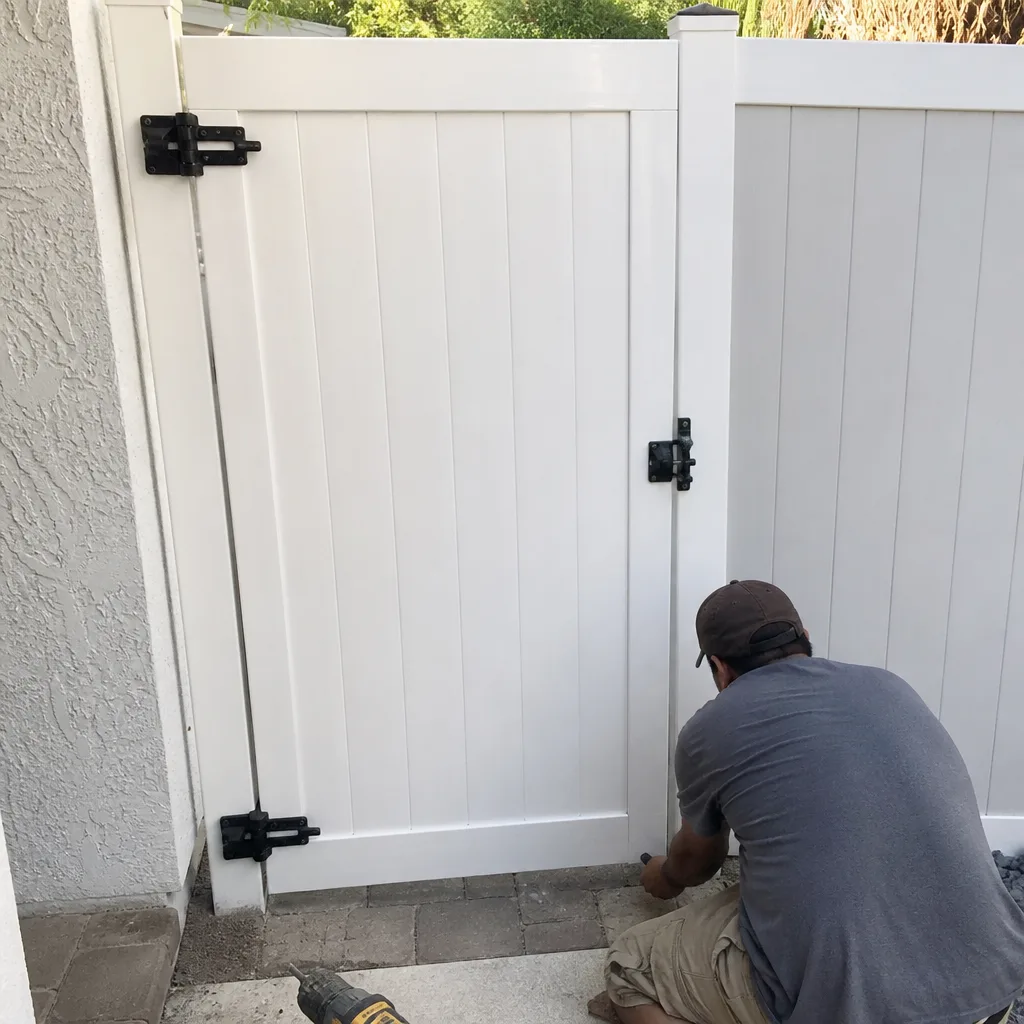 After