Last updated October 30, 2026
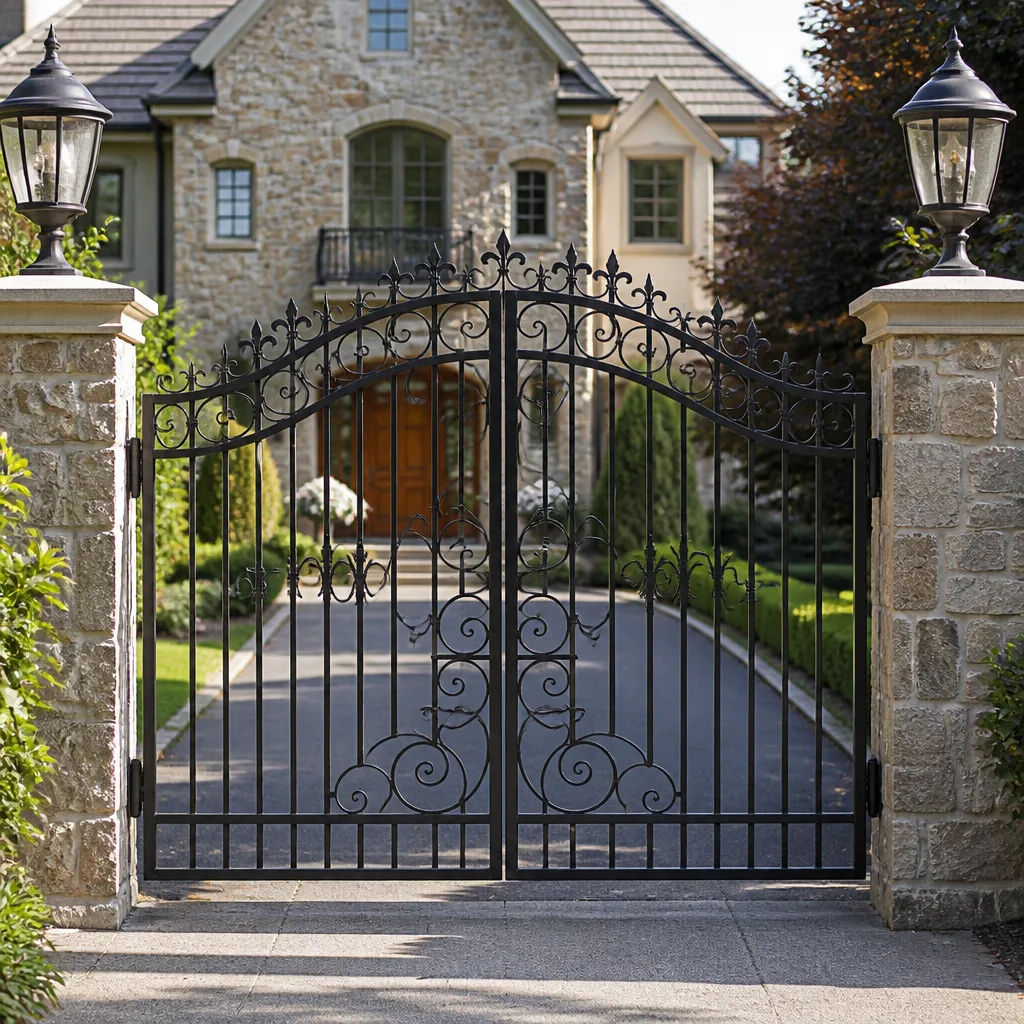 Wrought iron
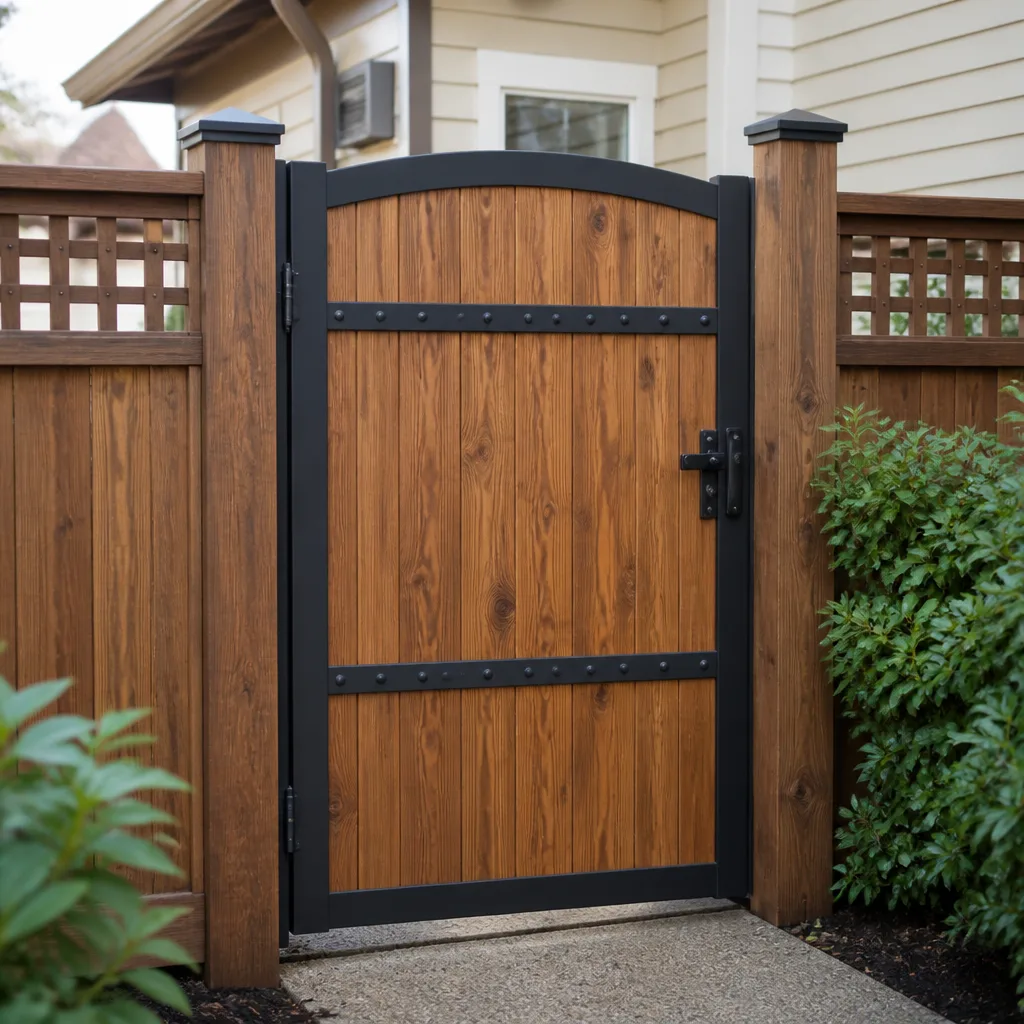 Wood & steel frame
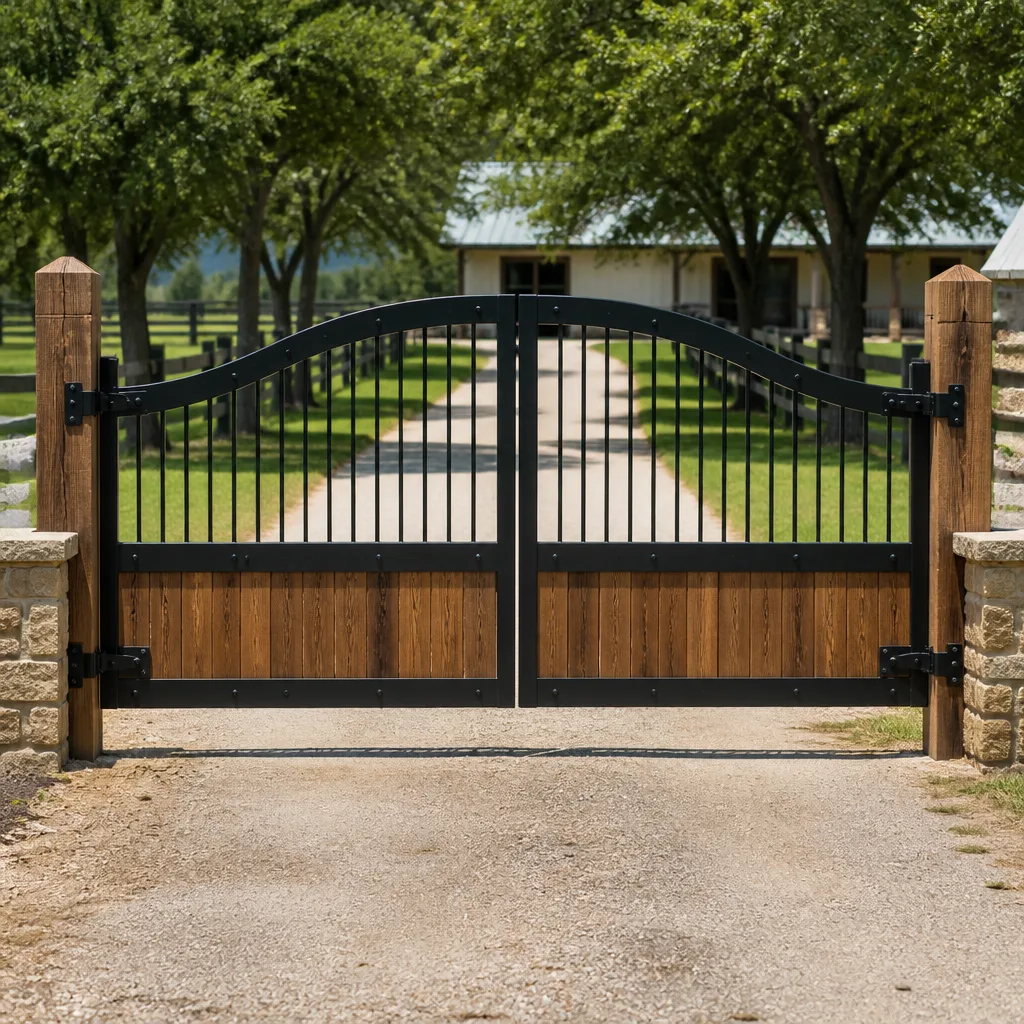 Farm & ranch
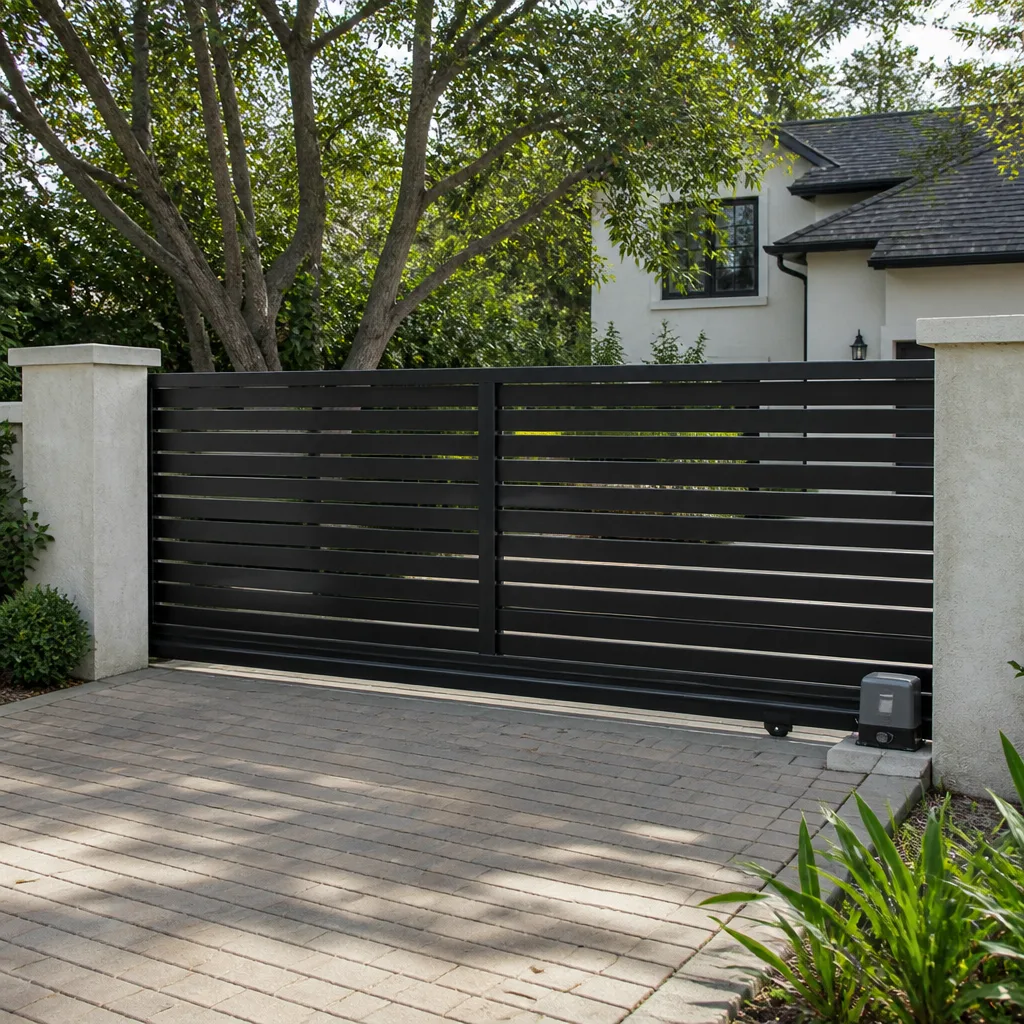 Sliding driveway gates
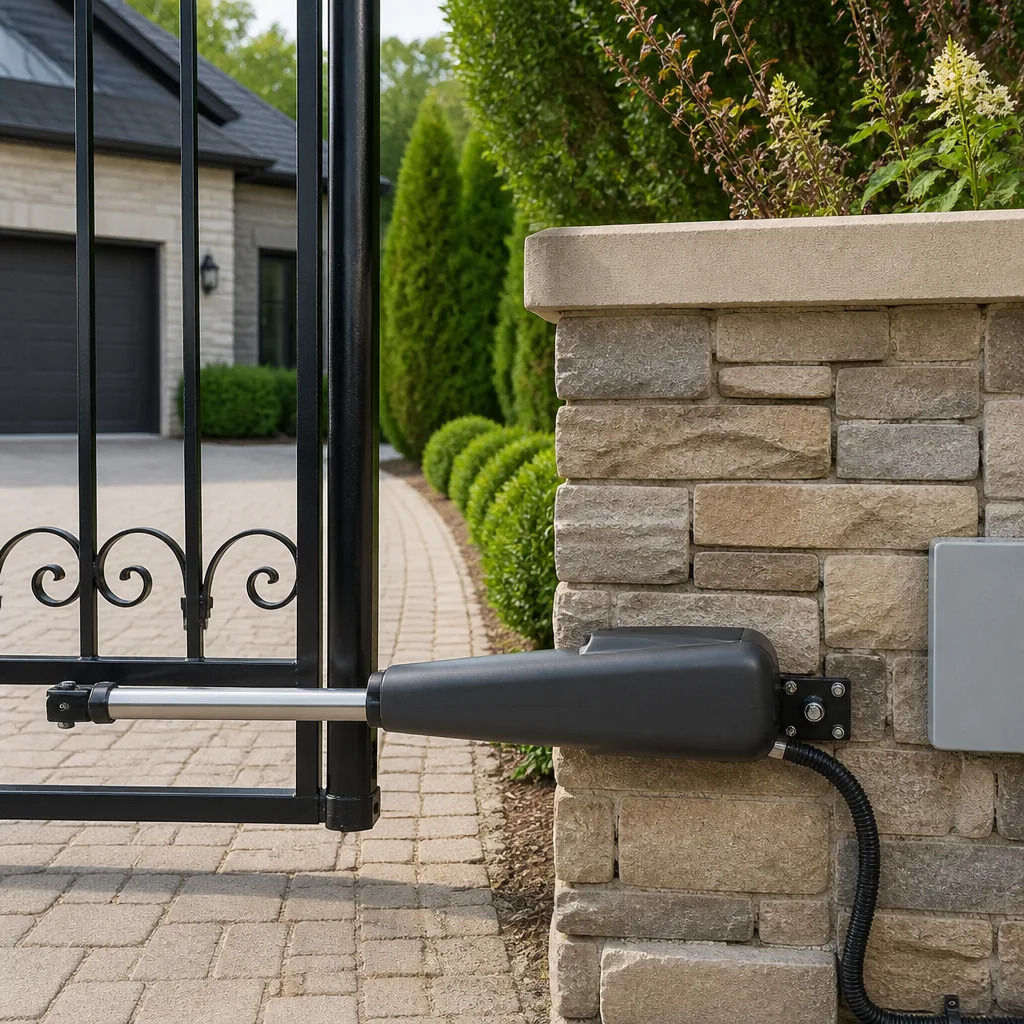 LiftMaster operators
Free on-site gate assessment - hinges, posts, and your LiftMaster or Nice gate operator checked before anything is quoted
The assessment is free and the quote is the invoice.
Get your free estimateHow to Hire a Gate Repair Contractor in Daytona Beach: A Step-by-Step Guide
Most homeowners in Daytona Beach assume any contractor who hangs a shingle can fix an automated driveway gate. That assumption is expensive. The coastal humidity, salt air, and afternoon thunderstorms here punish gate electronics faster than inland communities, and every failed jobsite we’re called to correct in Daytona Beach has one thing in common: the original contractor couldn’t identify the operator before opening the housing. This guide walks through the exact steps to find a contractor who can diagnose a system on the first visit, quote parts by brand name, and stand behind the work after hurricane season ends. For Gate Repair services that meet these standards, knowing what to ask is essential.
Quick Answer
Hire a gate repair contractor in Daytona Beach by verifying Florida licensing specific to automated gate work, asking brand-specific diagnostic questions (FAAC, DoorKing, LiftMaster, Mighty Mule), requiring itemized quotes that separate labor from parts, and checking that the contractor stocks or sources name-brand boards rather than aftermarket substitutes. A gate specialist who can name your operator’s board and fault codes before quoting is the difference between a one-visit repair and a three-month saga.
Styles & brands we work with
Table of Contents
- Step 1: Learn What Kind of Gate You Actually Have
- Step 2: Understand Florida’s Licensing Categories for Gate Work
- Step 3: Ask the Interview Questions That Expose Gate-Fluent vs. Gate-Adjacent Contractors
- Step 4: Decode the Quote Line by Line
- Step 5: Watch for Daytona Beach-Specific Warning Signs
- Step 6: Verify Parts Sourcing Before You Sign
- Step 7: Nail Down the Warranty Terms in Writing
- Common Mistakes to Avoid
Step 1: Learn What Kind of Gate You Actually Have
Before you call anyone, open your operator housing and photograph the model plate. The brand, model number, and voltage are stamped there, and that information changes everything about how the call goes. In Daytona Beach, most residential communities built since 2005 use slide gates with LiftMaster or Mighty Mule operators. Older ocean-side properties in Ormond Beach and Ponce Inlet frequently run FAAC or Elite hydraulic swing systems, which are a different animal entirely. Knowing your system lets you skip directly to the qualifying questions.
Here’s the quick inventory that matters:
- Operator brand and model – printed on the board or housing. This drives parts availability and repair cost.
- Gate type – slide, swing, vertical pivot, or barrier arm. Each has different mechanical failure points.
- Power source – 120V AC household circuit, solar, or low-voltage direct current. Solar systems in Daytona Beach fail faster due to salt corrosion on panel connections.
- Access controls – keypad, telephone entry, RFID card, or intercom. If the gate opens for you but not for visitors, the issue is here, not in the motor.
- Age of the system – anything over 15 years old in coastal Volusia County may have discontinued parts, which shifts the repair-versus-replace conversation.
When you call a contractor and say “my Gatehouse gate won’t open,” a gate-fluent technician asks follow-up questions: which model, what happens when you press the button, does the board show a blinking code. A gate-adjacent contractor says “we’ll come take a look.” The first response costs you less money because the diagnostic work starts on the phone.
Step 2: Understand Florida’s Licensing Categories for Gate Work
Florida regulates gate work under three different licensing umbrellas, and not all of them cover automated systems. This is where many Daytona Beach homeowners get burned. A handyman with a general business license can legally replace hinges on a manual pedestrian gate. That same handyman wiring a 24V control board into a safety loop detector is operating outside their legal scope if they lack the electrical credential.
Here are the three categories as they apply to automated gate work in Florida:
- Certified or Registered Electrical Contractor (EC/ER) – Required for any work that touches line-voltage wiring, control boards, loop detectors, or safety sensors. If your gate operator runs on 120V AC and the repair involves the board or motor wiring, this is the credential to ask for.
- Certified General, Building, or Residential Contractor (CGC/CBC/CRC) – Covers structural gate installation, concrete pads, post setting, and mechanical hardware. A contractor with only this license can install a manual gate but cannot legally wire automated components.
- Specialty Structure or Aluminum Contractor – Scoped to fabrication and installation of gates and fences. Relevant for custom gate builds and structural repairs, but again, automation is outside this scope.
Ask for the license number up front and verify it on the Florida DBPR website before scheduling. A contractor who hesitates or changes the subject is telling you something important. The legitimate operators in Daytona Beach carry the credential and volunteer it. This is also why you should be cautious of out-of-area crews that appear after hurricanes or tropical storms. Many operate under reciprocal or temporary permits that expire before any warranty claim comes due.
Step 3: Ask the Interview Questions That Expose Gate-Fluent vs. Gate-Adjacent Contractors
The single best filter in this entire process is a three-minute phone interview. You’re not testing whether the contractor is polite. You’re testing whether they know gate automation as a discipline. Generic contractors fail these questions quickly, and their quotes tend to reflect the cost of learning on your gate.
Here are the questions to ask, and what a qualified answer sounds like:
Question 1: “What brands do you service?”
A gate specialist answers with manufacturer names. In our experience, the technicians who work on gates all day every day do not hesitate to list which operators they know intimately. You want a contractor familiar with at least a few of these: LiftMaster, FAAC, BFT, Linear, Viking, Ghost Controls, DoorKing, Elite, and Mighty Mule. If the response is “all brands” or “whatever you have,” and eye roll is appropriate. No technician knows every board on the market, and the ones who claim to are the ones who pull up YouTube in your driveway.
Question 2: “Can you diagnose a board failure over the phone?”
Board diagnostics are where gate-fluent separates from gate-adjacent. A FAAC 402 board blinks specific codes for specific faults. A DoorKing 9150 shows error diagnostics on a digital display. A LiftMaster LA400 has LED light patterns for limit and obstruction faults. A contractor who has never heard these model numbers relative to their fault codes is not adding value on a diagnostic visit. We ask customers to describe the blinking pattern or display readout before we even schedule a truck roll in Daytona Beach.
Question 3: “Do you stock boards locally or order them?”
Parts sourcing is the hidden cost driver in gate repair. If the contractor orders every part from an online warehouse, you are paying for two truck rolls minimum: one to diagnose, one to install after the part arrives. That doubles your labor. A dedicated gate contractor carries common boards for the brands they service or has a regional supplier with same-week availability. In Daytona Beach, this matters even more. Salt air shortens board life here, and the waiting list for certain FAAC and DoorKing parts after a storm surge can stretch into weeks.
Step 4: Decode the Quote Line by Line
A legitimate gate repair quote is boring. It lists a diagnostic fee, labor hours, part numbers, and tax. A vague quote is a warning. If the quote says “repair gate” as a single line item for $900, you have no idea what you’re buying, and neither does the contractor.
Here’s how to evaluate a quote line by line:
- Diagnostic fee – $75 to $150 is normal in the Daytona Beach market. A diagnostic fee is not a red flag. A diagnostic fee that is not credited toward the repair if you proceed is. Ask up front.
- Labor rate – expect $85 to $125 per hour for licensed gate work in Volusia County. Anything far below that is either unlicensed or will make up the difference in parts markup.
- Parts with manufacturer part numbers – a quote that says “control board” without a part number is a quote for an aftermarket board. Legitimate boards have manufacturer part numbers: LIFTMASTER K1D8387-1C, FAAC 455D, DoorKing 9150-380. Ask for the number and Google it.
- Separate line items for safety sensors – UL 325 compliance requires photo eyes or contact edges on automated gates. If a full system replacement doesn’t include safety sensors as a line item, run.
- Concrete or pad work if applicable – post replacement, pad repouring, or track realignment should be itemized separately from the operator repair.
A detailed quote is a sign of a contractor who has done this before. Daytona Beach property managers, especially those handling HOAs and apartment complexes running DoorKing or FAAC commercial operators, should demand this level of line-item detail every time. The alternative is a lump-sum quote that hides aftermarket parts under generic labels, which leads to the exact scenario in our next section.
Step 5: Watch for Daytona Beach-Specific Warning Signs
The Daytona Beach gate repair market has predictable patterns, and some of them are tied to geography. Understanding these patterns before you hire saves you from decisions that look fine in March and fall apart in September. Our Seasonal Gate Repair Care for Daytona Beach: Year-Round Homeowner’s Guide covers what to expect each season.
Here are the warning signs specific to this market:
- The post-storm contractor – after every hurricane or major tropical storm, out-of-area crews canvas Daytona Beach, Ormond-by-the-Sea, and Port Orange neighborhoods with flyers for “storm-damage gate repair.” Many are legitimate. Many are not. They take deposits, complete superficial repairs, and leave the county before the warranty period ends. Check for a Volusia County business address and Florida license before handing over any money.
- The salt-air up-sell – some contractors will tell you that your gate’s rusted hinges or corroded board are unfixable and that you need a full replacement. Sometimes that’s true. More often, the mechanical components can be salvaged and the board replaced at a third of the cost. A gate specialist distinguishes between corrosion that’s cosmetic and corrosion that’s structural.
- The “just replace the board” without diagnostics – a contractor who recommends board replacement without checking the power supply, wired connections, and safety sensor loop hasn’t diagnosed anything. We see this constantly in coastal Daytona Beach, where voltage irregularities from storm surges fry multiple components at once. Replacing a board without tracing the source of the problem means you’ll replace the board again in six months.
- Cash-only pricing or waived permits – legitimate gate work in Florida often requires a permit, particularly for new installations and structural repairs. A contractor who offers to skip permits to “save you money” is asking you to accept liability for code violations and insurance complications down the road.
Step 6: Verify Parts Sourcing Before You Sign
The parts substitution problem deserves its own section because it is the most common way Daytona Beach homeowners overpay for gate repair. See our Choosing the Right Gate Repair Brand: A Buyer’s Guide for Daytona Beach for help selecting a reliable contractor. Here’s how the pattern works: the contractor quotes a name-brand board at name-brand prices, then installs a generic aftermarket unit that costs 60% less and fails within a year. By the time you notice, the contractor has a new phone number.
How to protect yourself:
- Require manufacturer part numbers in writing – if the quote says “LiftMaster board” without a model-specific number, ask for it. If the contractor refuses, move on.
- Ask to see the old part – after the repair, the removed board or actuator is yours. A contractor who won’t show you the failed component is hiding something about what they replaced.
- Verify the warranty path – name-brand parts from FAAC, DoorKing, Elite, and Mighty Mule carry manufacturer warranties. Aftermarket parts carry whatever the seller claims, which is usually nothing enforceable. A gate specialist installs manufacturer parts specifically so the warranty chain remains intact.
- Beware of “universal” replacement boards – generic multi-brand boards are marketed as cheaper alternatives to OEM parts. They fail faster in coastal humidity, they do not integrate cleanly with safety sensors, and they void whatever remains of your operator’s manufacturer support.
This is also why hiring a contractor who is technically trained on specific brands matters. The technicians who know Ghost Controls and Mighty Mule systems from daily field work also know which aftermarket parts those systems tolerate and which ones they reject. That knowledge does not come from a parts manual. It comes from installing and repairing these systems in this climate, in this market, over enough years to see which patterns repeat.
Step 7: Nail Down the Warranty Terms in Writing
Warranty is the final filter. The way a contractor handles warranty questions tells you how they’ll handle the repair itself. Here are the specific questions to ask, and what the answers mean.
Ask for the warranty in writing, not in words. A verbal promise is worth nothing on a January afternoon when your gate refuses to close and the contractor’s phone goes to voicemail. The written document should state:
- Parts warranty period – 90 days is standard minimum. One year is what a confident contractor offers on name-brand boards and actuators.
- Labor warranty period – minimum 30 days. If the repair fails due to the contractor’s workmanship within that window, you should not pay a second diagnostic fee or labor charge.
- What voids the warranty – damage from storms, vehicles, or DIY adjustments. This should be explicit, not discovered later.
- Transferability – if you’re selling a Daytona Beach property with a recently repaired gate, does the warranty transfer to the new owner? This matters more in the beachside condo and HOA market where properties turn over frequently.
One more consideration: the warranty is only as good as the contractor’s presence. A Daytona Beach-based gate company that serves this market year-round is accountable to local reputation. An out-of-town subcontractor that appears after a storm is accountable to nobody. This is not a guarantee about any specific company. It’s a structural reality of how local service markets work.
For homeowners who want a deeper dive into what gate repair actually involves, our Regent Gate Repair home page covers the full scope of residential and commercial service. If you’re in neighboring Flagler County, we’ve put together a full guide on Gate Repair in Flagler Beach that covers the same ground for that coastal market.
Common Mistakes to Avoid
- Calling a general handyman for an automated gate – handymen are fine for many jobs. Rewiring a control board is not one of them. The Florida licensing and liability questions alone should give you pause.
- Accepting the lowest bid without comparing scope – the lowest bid on gate repair almost always means cheaper parts, fewer replaced components, or both. The quote with a $220 aftermarket board will undercut the quote with a $400 OEM LiftMaster board every time. And the aftermarket board will fail in eighteen months of salt air.
- Skipping the license verification step – five minutes on the DBPR website can reveal whether your contractor is legally entitled to touch automated electrical work. Most homeowners skip this. Don’t be most homeowners.
- Replacing a whole system when a component failure is the actual problem – we regularly see this in Daytona Beach: a $150 safety sensor failure or a $400 board replacement gets quoted as a $4,500 full operator replacement. Get a second opinion from a gate specialist before signing a full replacement contract, especially if the first quote came from a contractor who also does fences, decks, and roofs.
- Ignoring the safety sensors – UL 325 requires automated gates to have photoelectric sensors or contact edges that reverse the gate on obstruction. A contractor who quotes a repair or installation without addressing these sensors is not doing a legal installation. This is not optional.
- Paying the full amount up front – deposits on special-order parts are reasonable. 100% up front is not. Reputable contractors invoice after the work, or split payment between deposit and completion.
See the difference
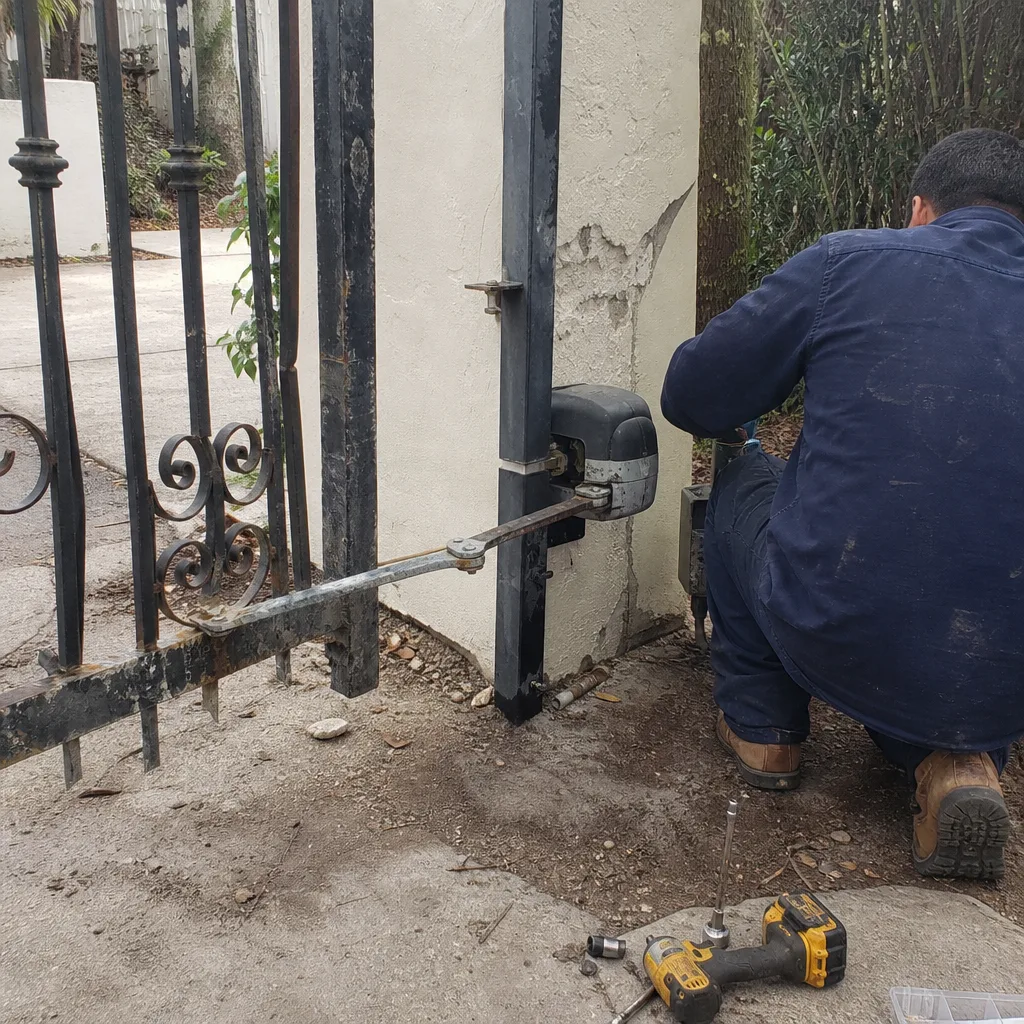 Before
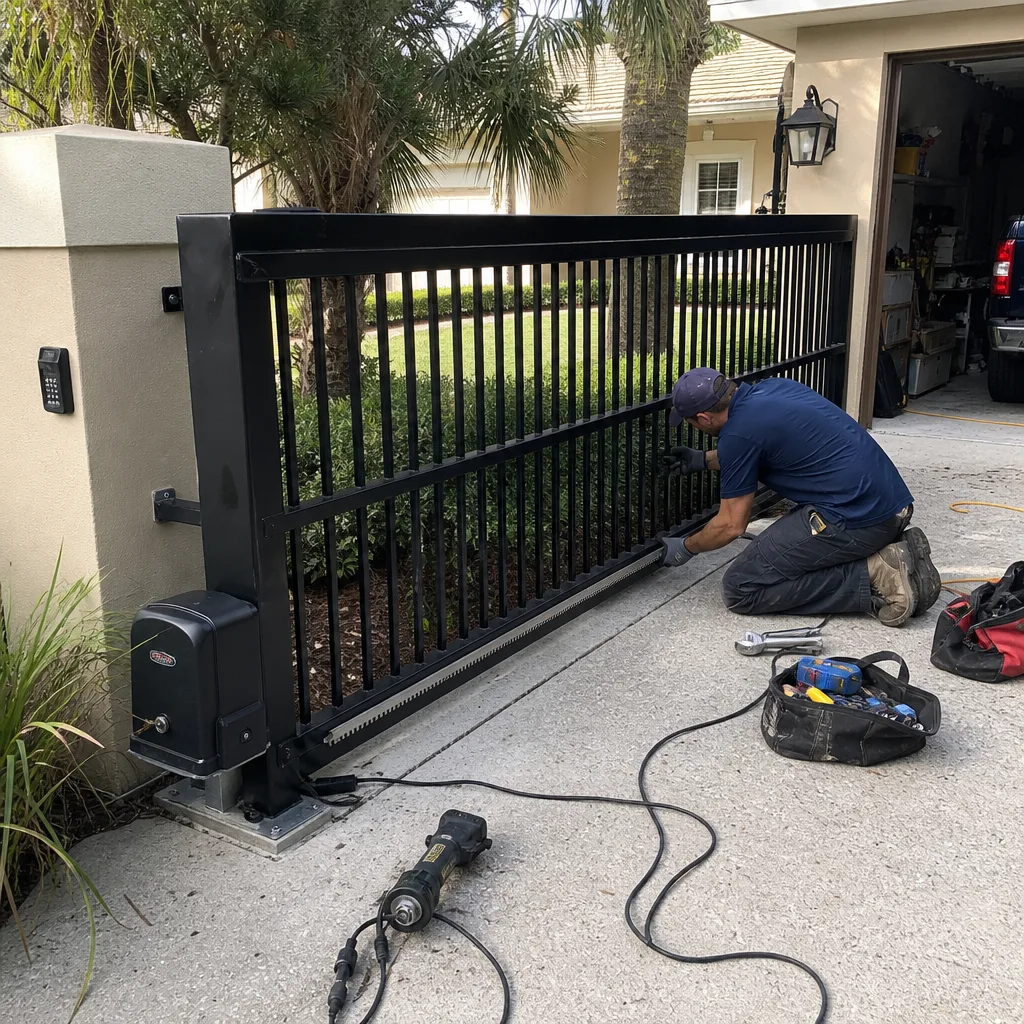 After
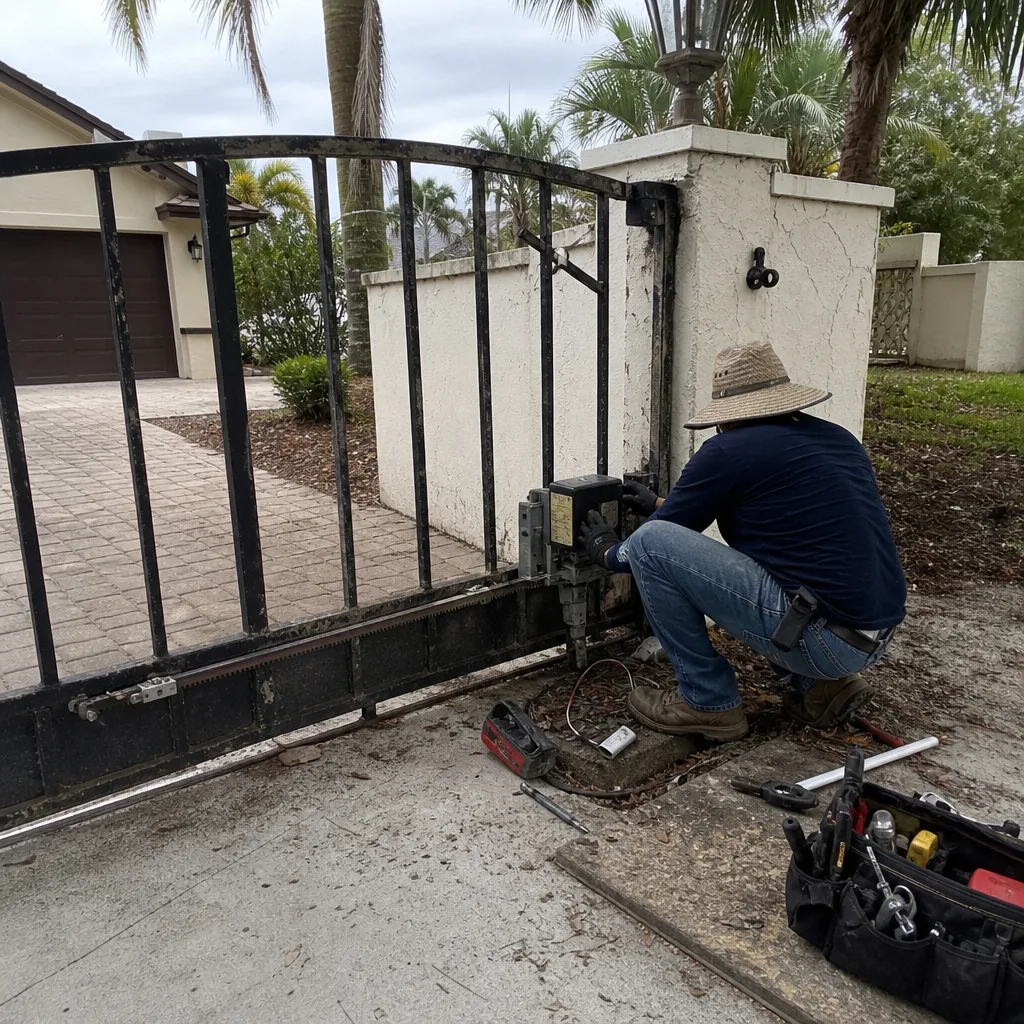 Before
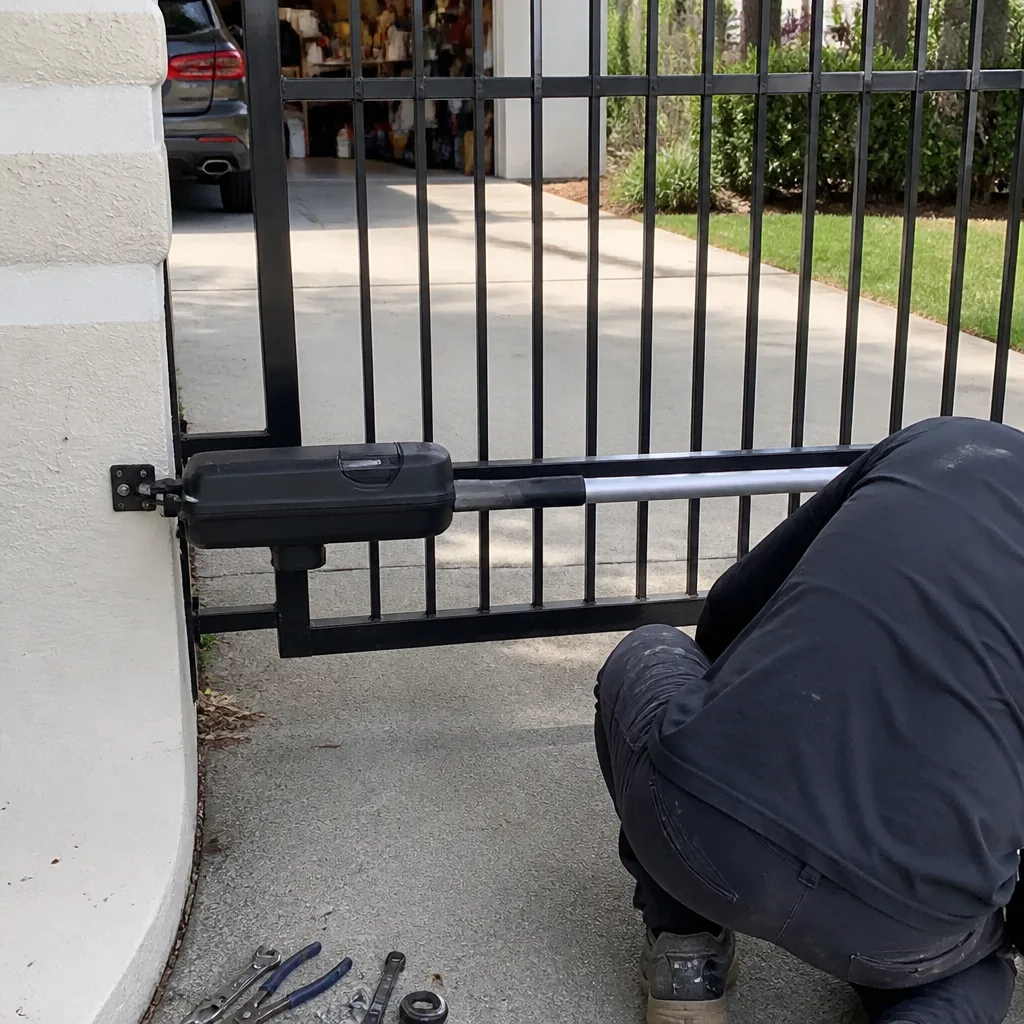 After
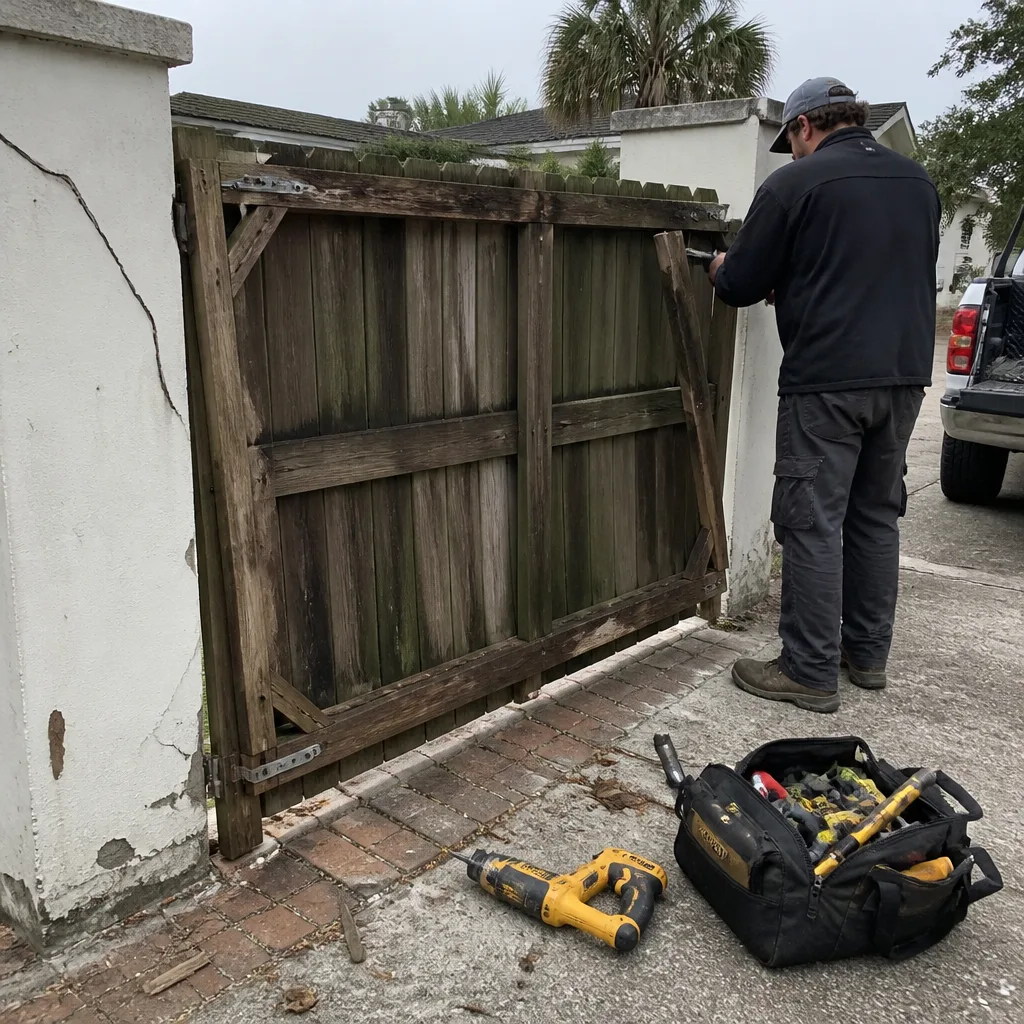 Before
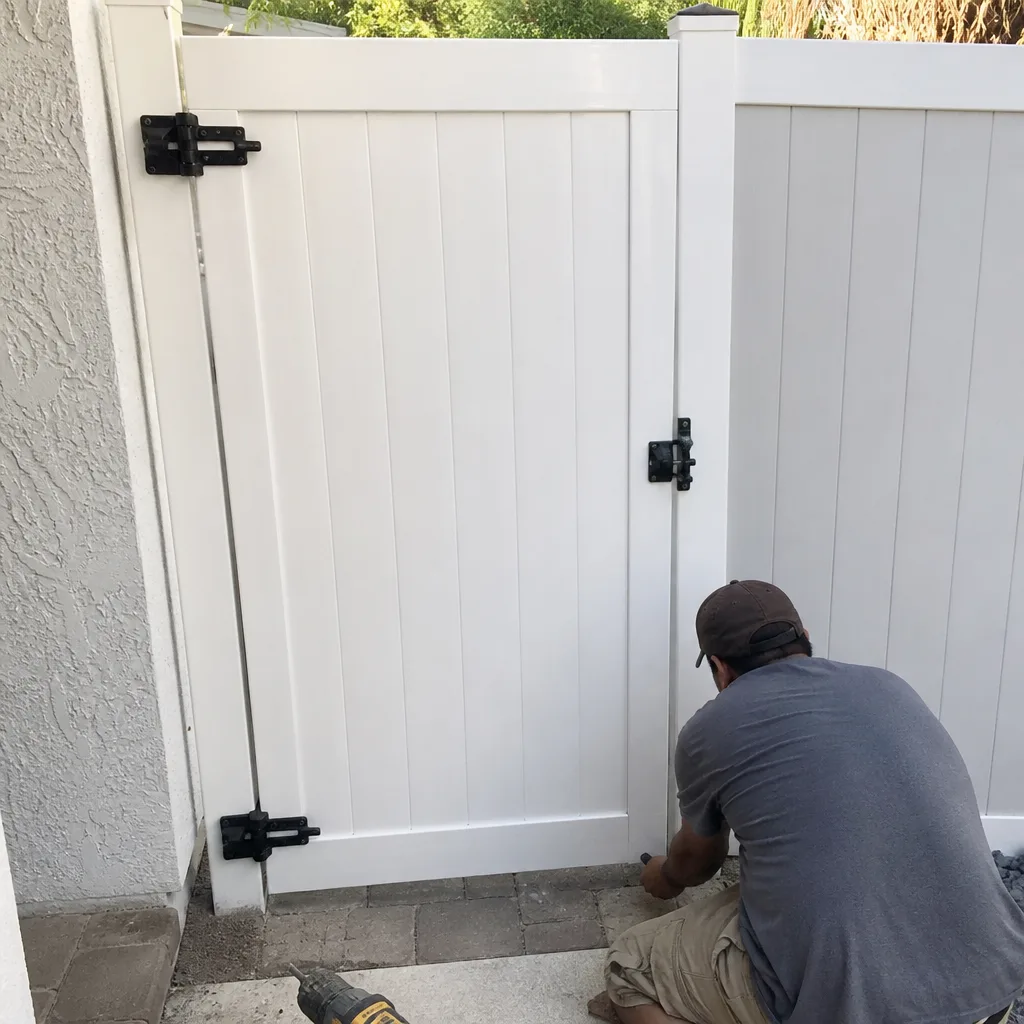 After
When to Call a Professional
Some gate issues are safe to note and report. Others require a licensed professional immediately. If your gate is sparking, emitting a burning smell, or moving erratically with visible wire damage, disconnect the power at the breaker and call a licensed gate contractor. The same applies to gates that won’t reverse when they hit an obstruction, gates that open or close without command (ghost operation), and any repair involving the high-tension springs on cantilever or swing gate systems. Those springs carry enough stored energy to cause serious injury. Watch for the symptoms, report them accurately, and let a trained technician do the hands-on work. Regent Gate Repair offers free estimates in Daytona Beach – call (855) 927-1091 and we’ll talk through what your gate is doing before we even schedule a visit.
If you’re considering a full replacement rather than a repair, our Gate Installation in Flagler Beach page walks through the process and pricing for complete system swaps. For automated systems specifically, the Electric Gate Repair in Flagler Beach guide covers control boards, loop detectors, and safety sensor work in detail.
Frequently Asked Questions
Request the contractor’s Florida license number and verify it on the Florida Department of Business and Professional Regulation website (myfloridalicense.com). For automated gate work, the license should be an electrical contractor credential (EC or ER). For structural installation, a certified general, building, or residential contractor license (CGC, CBC, or CRC) applies. Verify before scheduling, not after.
A diagnostic fee from $75 to $150 is standard for gate repair in the Daytona Beach market, and it should be credited toward the repair if you proceed with that contractor. A diagnostic fee is a positive signal: it means the contractor’s time is priced, the visit has structure, and you get a real diagnosis rather than a sales pitch. When we diagnose a gate, the fee covers the initial service call and our time tracing the fault, and it applies to whatever repair you approve.
OEM parts are made by or for the original manufacturer (FAAC, DoorKing, LiftMaster, Mighty Mule) and carry that manufacturer’s warranty. Aftermarket parts are third-party substitutes sold at lower prices, often marketed as “compatible” or “universal.” They fail faster in Daytona Beach’s salt air and high humidity, they don’t integrate cleanly with manufacturer safety sensors, and they void any remaining warranty on your operator. Insist on OEM parts with manufacturer part numbers on the quote.
No. A handyman without the electrical contractor license cannot legally perform the wiring, board replacement, or sensor work required to repair an automated gate operator in Florida. Anyone can replace a hinge. The moment the work touches line voltage, low-voltage control wiring, or safety sensor circuits, it falls under electrical licensing requirements. Ask for the license number before allowing anyone to open an operator housing.
Compare the cost of a proper repair (including OEM parts and two visits) against the cost of a new operator installed. If the repair approaches 50-60% of replacement cost on an operator older than 10 years, replacement is often the better financial decision. A gate specialist can tell you if your specific operator’s parts are still manufactured or if you’re paying collector prices for discontinued hardware. That single fact changes the math entirely.
The variation comes from parts selection. Two contractors can quote the same repair: one uses an OEM FAAC or DoorKing board at $400-600, the other uses a generic substitute at $150-220. Both quotes say “control board replacement.” Only one will last through five years of Volusia County salt air. Ask for manufacturer part numbers in writing and the variation disappears – you’ll see exactly where the difference lies.
The Bottom Line
Hiring a gate repair contractor in Daytona Beach is a filtering process, not a search process. The filters are licensing, brand fluency, parts sourcing, and warranty terms. Apply them in that order and you’ll consistently land on a contractor who can repair your gate correctly the first time. Skip them and you’re gambling with the second most important security feature on your property. Ask the specific questions. Demand the part numbers. Verify the license. And when in doubt, call a gate specialist – not a contractor who also does gates. Regent Gate Repair offers free estimates in Daytona Beach. Call (855) 927-1091 to talk through your gate system, your symptoms, and your options before we ever set a truck on the road.
Written by the team at Regent Gate Repair, serving Daytona Beach since 2013. Explore more guides & resources on gate maintenance and repair.