Last updated October 30, 2026
 Wrought iron
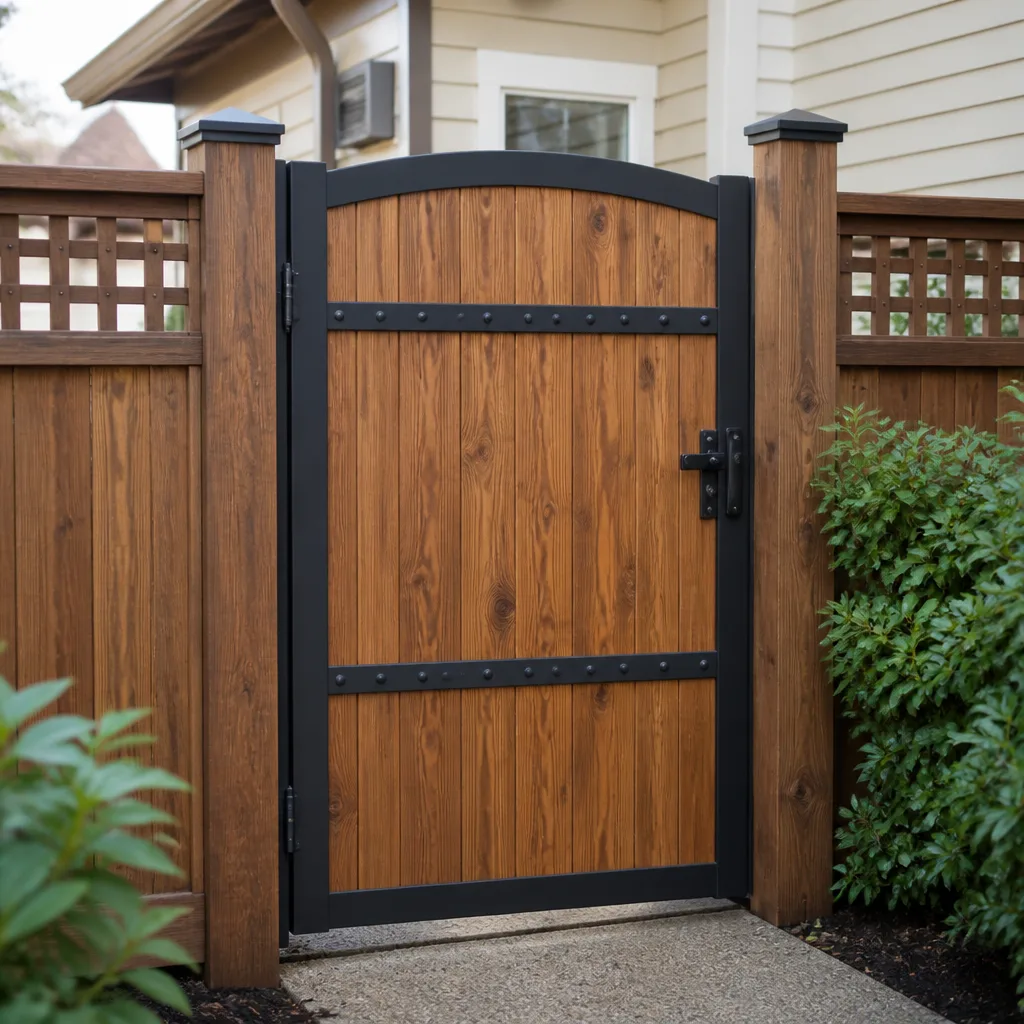 Wood & steel frame
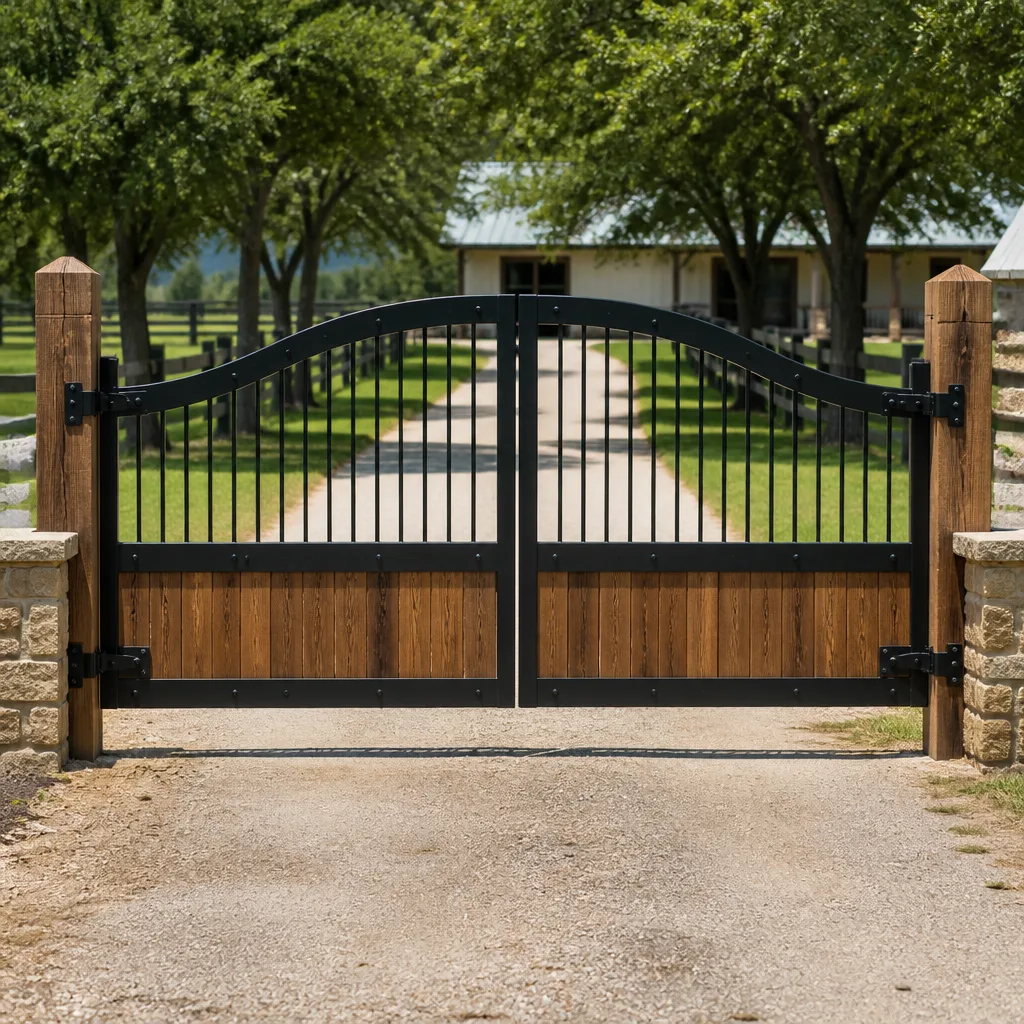 Farm & ranch
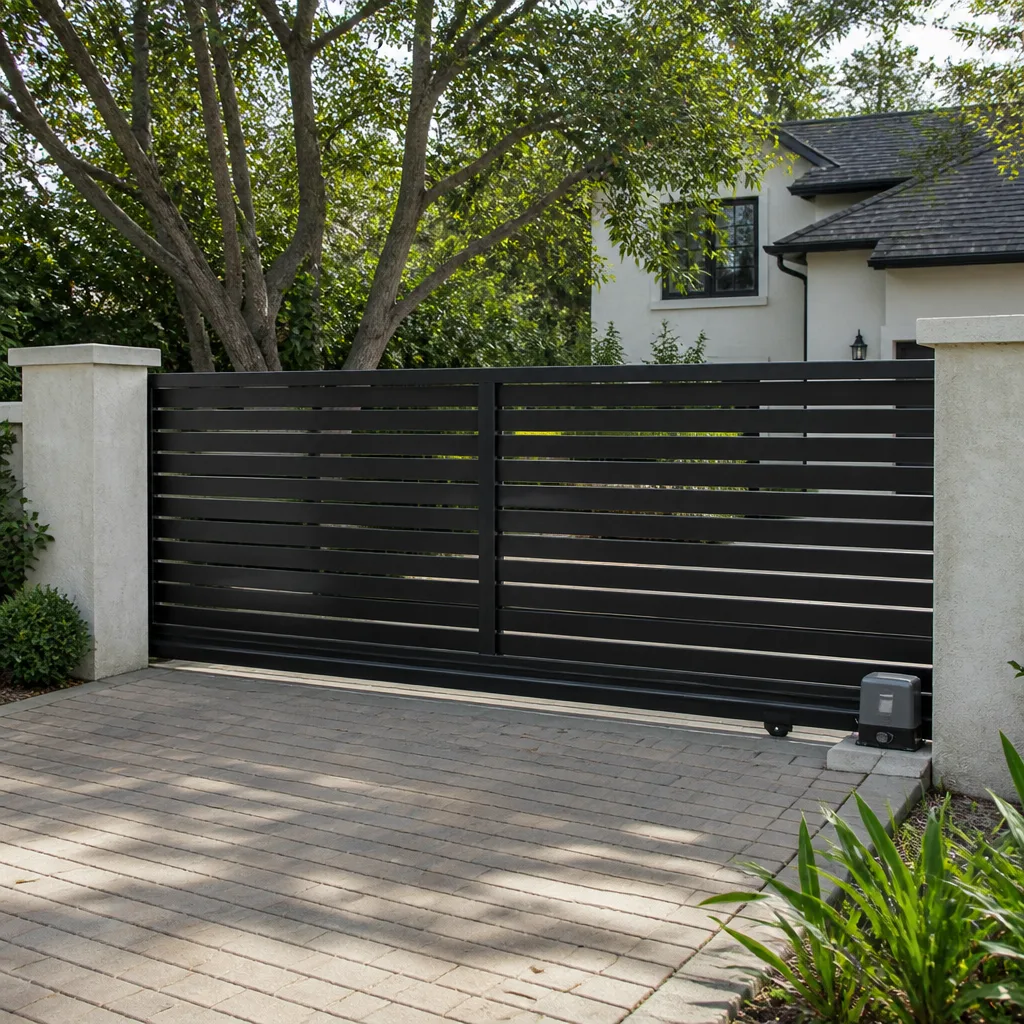 Sliding driveway gates
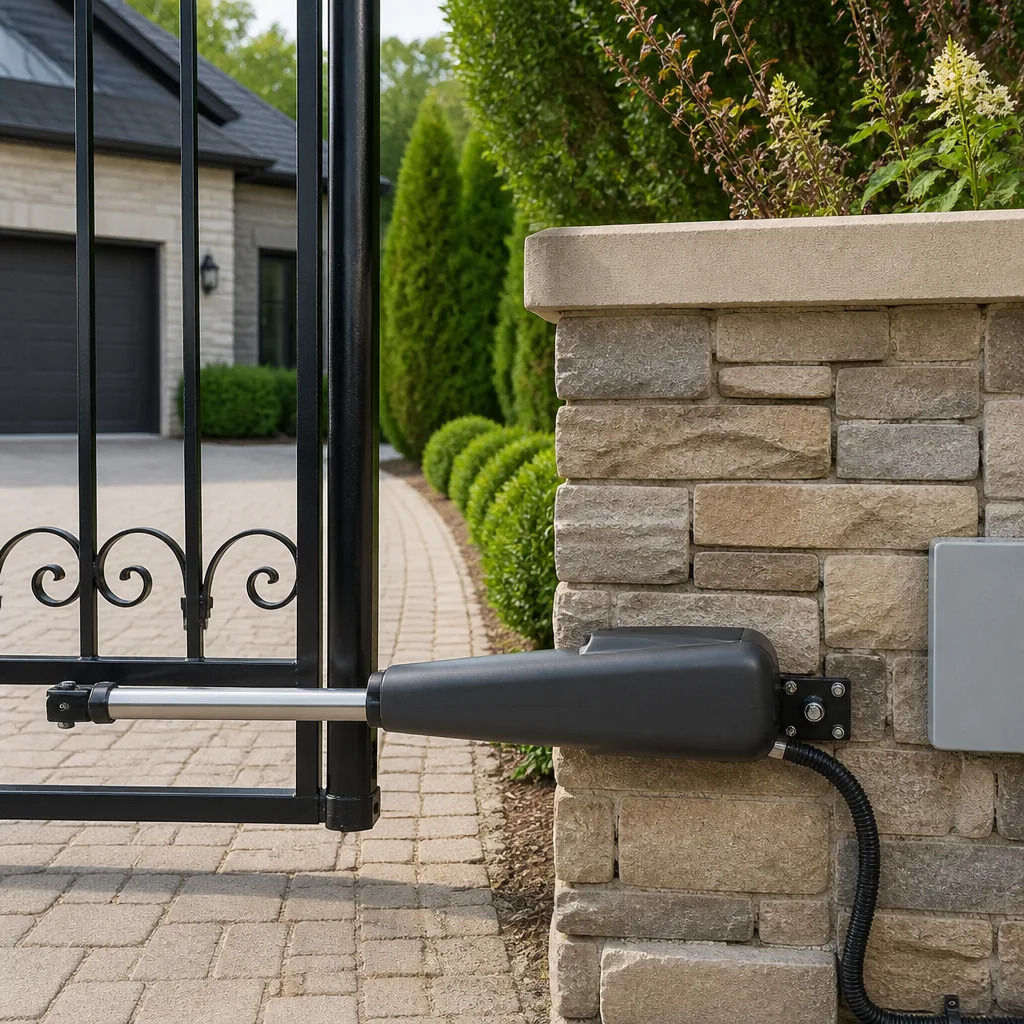 LiftMaster operators
Free on-site gate assessment - hinges, posts, and your LiftMaster or Nice gate operator checked before anything is quoted
The assessment is free and the quote is the invoice.
Get your free estimateDIY vs Professional Gate Repair: The Daytona Beach Homeowner’s Decision Guide
Here’s a number most Daytona Beach homeowners never hear: roughly four out of every ten gate repair calls we respond to involve damage that started as a DIY attempt. Not neglect, not age, not salt air. A homeowner with a multimeter and a YouTube tutorial. The counterintuitive truth about gate repair is that the dividing line between “I can handle this” and “I need a specialist” has almost nothing to do with how handy you are. It has everything to do with which failure mode you’re facing. Mechanical problems forgive mistakes. Electrical and logic-board problems don’t. This guide draws that line precisely, so you know exactly which side of it you’re standing on before you touch a single screw. For professional help, see our Gate Repair services.
Styles & brands we work with
Quick Answer
DIY gate repair in Daytona Beach is genuinely safe for mechanical tasks: lubricating hinges, aligning photo-eyes, replacing remote batteries, and resetting a tripped breaker. It stops being safe the moment the problem involves a control board, underground wiring, or hydraulic seals, where one wrong move can turn a $150 repair into a $600 operator replacement. When in doubt, the diagnostic step is free: read the operator’s error code, check the basics, and call a gate specialist at (855) 927-1091 before opening an electrical panel.
Table of Contents
- The Real Question: Mechanical vs Electrical Failure
- Genuinely DIY-Safe Gate Repairs (And How to Do Them Right)
- Repairs Where DIY Attempts Make Things Worse
- Florida-Specific Risks: Salt, Humidity, and Code Compliance
- The Hidden Cost of DIY Escalation: When a $30 Fix Becomes a $600 Replacement
- How to Use Your Operator’s Diagnostic Mode Safely
- Brand-Specific Failure Patterns: What We See in Daytona Beach
- Common Mistakes to Avoid
- When to Call a Professional
- Frequently Asked Questions
- The Bottom Line
The Real Question: Mechanical vs Electrical Failure
Every gate system, whether it’s a sliding cantilever at a Daytona Beach condo complex or a dual swing gate on a residential driveway off Nova Road, breaks down in one of two ways. Either something mechanical stops moving the way it should, or something electrical stops telling the mechanical parts what to do.
Mechanical failures are physical. A hinge binds. A roller wears flat. A chain stretches. A wheel bearing seizes from sand intrusion. These problems announce themselves with grinding, squealing, sagging, or visible wear. They’re tactile. You can see them, hear them, and often feel them. Best of all, mechanical parts are forgiving. If you misalign a hinge, the gate still works. If you over-tighten a bolt, you can loosen it. The cost of a mechanical mistake is usually just time.
Electrical failures are different. They live inside control boards, run through buried conduits, and travel along low-voltage wiring that looks identical to line-voltage wiring until you test it. An electrical mistake is not forgiving. Bridge the wrong two terminals on a LiftMaster board and you’re not buying a new bolt. You’re buying a new board. And that board costs between $300 and $700 depending on the model.
The skill question is a red herring. A careful homeowner with a wrench can fix a sagging gate. A careful homeowner with a multimeter can still destroy a gate operator, because the hazard isn’t carelessness. It’s knowledge that can only come from working on these specific systems repeatedly.
Genuinely DIY-Safe Gate Repairs (And How to Do Them Right)
We’re not here to tell you to call a professional for everything. Some gate maintenance is not only safe for homeowners, it’s expected. In fact, we’d rather you handle these items yourself. It saves you money and keeps small issues from becoming service calls. Here’s the definitive list of what you can do safely.
1. Lubricating hinges and rollers
Salt air in Daytona Beach accelerates corrosion on any exposed metal pivot point. Hinges, rollers, and chain drives all need lubrication every three to six months depending on how close you are to the beach. Use a white lithium grease or a dry silicone spray. Avoid WD-40 as a long-term lubricant. It displaces moisture but doesn’t leave enough lasting film for gate hardware. Apply lubricant, cycle the gate three or four times to work it in, and wipe away excess. This is a ten-minute job that prevents premature wear.
2. Aligning photo-eye sensors
Photo-eyes are the small sensors mounted near the bottom of the gate opening on both sides. If the gate starts to close and immediately reverses, the photo-eyes are usually the culprit. Most models have an indicator light. If it’s blinking or off, the alignment is off. Loosen the mounting bracket, adjust the sensor until the light goes solid, and tighten. Check that nothing is blocking the infrared beam. In Daytona Beach, spiders love building webs across photo-eye lenses. A quick wipe with a dry cloth fixes more reversing gates than any tool we carry.
3. Replacing remote batteries
If your remote’s range is shrinking, the battery is the fix roughly 90 percent of the time. Mighty Mule and Ghost Controls remotes use standard coin or 9-volt batteries. Pop the case open, match the battery type printed on the old one, and replace. No programming needed. The remote’s code is stored on a chip, not in the battery.
4. Resetting a tripped breaker
Gate operators run on their own circuit in most Daytona Beach homes. After a lightning storm or a power surge, that breaker can trip. Find your panel, identify the gate breaker (it’s usually labeled, but if not, look for a dedicated 15 or 20 amp circuit), and flip it fully off, then back on. If the breaker trips again immediately, stop. That’s a short, not a surge, and it needs a diagnostic call.
5. Cleaning solar panels on solar-powered operators
Many Daytona Beach gates, especially those on properties without easy electrical access, run on Mighty Mule solar setups. The panels collect dust, pollen, and salt film. A clean panel produces meaningfully more charging current than a dirty one. Wipe the panel with a damp cloth monthly during pollen season. That’s it. No disassembly, no risk.
These five tasks account for a meaningful fraction of the service calls we get in Daytona Beach. Do them consistently and you’ll avoid some of the most common failures entirely. If you’re already doing these and the gate still misbehaves, see the next section, or browse more guides & resources.
Repairs Where DIY Attempts Make Things Worse
Now the other side of the line. These are the repairs where we’ve watched well-intentioned homeowners in Daytona Beach transform minor problems into major expenses. The pattern is consistent: the fix looks simple on the surface, but the failure mode underneath is invisible until you’ve already done the damage.
Control board diagnostics and replacement
This is the big one. When a gate operator stops responding, the control board is often the problem. But “the control board is the problem” is a diagnosis, not a symptom. Boards fail for reasons. A short in the wiring. A failed loop detector. A power surge from a lightning strike. A dead capacitor. If you replace a board without resolving the underlying cause, you burn through the new board the same way you burned through the old one. We’ve replaced boards in Daytona Beach that were the third one the homeowner had installed, and the underlying short was still active.
Underground wiring faults
Gate wiring runs underground from the operator to the photo-eyes, the keypad, and the loop detector. In Daytona Beach’s sandy, shifting soil, those conduits crack. Water intrudes. The wire corrodes. The symptom is usually intermittent: the gate works, then doesn’t, then works again. The DIY response is to start pulling wires and testing continuity, but without knowing which wire carries line voltage and which carries low-voltage signal, you’re working blind. Worse, probing a live wire with the wrong meter setting can send 120 volts through a low-voltage circuit and fry the board you were trying to protect.
Hydraulic operator seals
FAAC and BFT hydraulic operators are common on Daytona Beach commercial properties and some larger residential estates. When a hydraulic gate starts drifting or moving slower than normal, the cause is usually a failing seal inside the operator. The repair requires depressurizing the system, replacing the seal, and refilling with the correct hydraulic fluid. Get any step wrong and you have two problems: a gate that still doesn’t work and a hydraulic fluid spill that’s an environmental hazard. This is not a weekend project. This is a specialist repair, and any gate technician who tells you otherwise is guessing.
Line-voltage electrical work
In Florida, residential electrical work is governed by the Florida Building Code and, in most municipalities, requires a licensed electrical contractor for line-voltage modifications. Your gate’s operator connects to 120-volt line voltage. That connection point is not a DIY zone. Even if you’re comfortable with household wiring, the gate’s internal wiring is not household wiring. It’s a hybrid system with low-voltage control circuits running alongside line-voltage power. Crossing them is where the damage happens. A Regent Gate Repair home service call covers this correctly: the electrical work is done to code, the low-voltage diagnostics are done to the manufacturer’s spec, and the wiring stays separated the way it was designed to be.
Florida-Specific Risks: Salt, Humidity, and Code Compliance
Daytona Beach is not a neutral environment for gate hardware. It’s a salt-air environment with high humidity, frequent afternoon thunderstorms, and a hurricane season that tests every outdoor electrical installation. These conditions shape which failures are common here and which repairs are riskier than they’d be elsewhere. See our Gate Repair Emergency Preparedness Guide for Daytona Beach Homes to prepare for storm season.
Salt air corrodes electrical contacts. Connectors that would last a decade inland start failing in three to five years near A1A. When a gate stops working after a storm, the cause is often a corroded connector or a water-intruded conduit, not a failed operator. A homeowner who doesn’t understand this pattern is likely to replace the wrong part. We diagnose by checking the wiring path first, because in Daytona Beach, the wiring path is usually where the problem lives.
Humidity accelerates degradation of exposed circuit boards, especially in operators that aren’t fully sealed. Moisture condenses inside the enclosure, and over time, that condensation corrodes the board’s traces. If you open a control panel and see white or green residue on the board, that’s corrosion. The fix is a board cleaning or replacement, but it also requires checking the enclosure seal. Otherwise, the new board will corrode too.
Florida’s building code also matters. In Miami-Dade and Broward counties, stricter wind-load standards apply, but Daytona Beach is in Volusia County, which still requires gates to meet wind-resistance standards for hurricane preparedness. If you’re modifying your gate’s structure, like removing a panel or changing the operator type, you may need a permit. A gate specialist who works in Daytona Beach regularly knows the local permitting landscape. A homeowner who skips this step can face fines or insurance complications if the gate fails during a storm.
Electrical code compliance is the real liability. Florida requires line-voltage electrical work to be performed by licensed electricians. If your DIY gate repair accidentally bypasses a required ground fault interrupter or creates a shock hazard, and someone gets hurt, your homeowner’s insurance may not cover the claim. That’s not a hypothetical. Insurers do investigate injury claims, and unpermitted electrical work is one of the first things they look for.
The Hidden Cost of DIY Escalation: When a $30 Fix Becomes a $600 Replacement
Let’s walk through the math that nobody posts in the YouTube comments. The most common DIY escalation we see in Daytona Beach follows a predictable pattern.
It starts with a gate that won’t open. The homeowner goes online, finds a forum post suggesting the problem is a bad limit switch. The part is $25 or $30 online. The homeowner orders it, opens the operator housing, and discovers the wiring doesn’t match the forum post. They improvise. They move wires. They test continuity with the power on. In the process, they bridge two terminals that should never touch.
Now the limit switch is installed, but the board is fried. The original problem, which was probably a corroded connector or a misaligned sensor, is still there. The new problem is a dead control board. The total cost to fix both problems professionally is now $600 or more, because a failed board is a part-and-labor replacement, not a component swap.
The $30 DIY attempt didn’t add $30 to the repair. It added $450. That’s the hidden cost. And it’s not an edge case. We see at least one of these escalation repairs every week in the Daytona Beach area, often on LiftMaster operators where the board sits close to the line-voltage terminals and the margin for error is measured in millimeters.
Compare this to the cost of the original repair. If a gate specialist had diagnosed the corroded connector, the repair would have been a connector cleaning or replacement at a cost of $150 to $200. The gate would have worked the same day, and the operator would still be original.
There’s a second hidden cost: time. A homeowner spends a weekend researching, ordering parts, waiting for shipping, taking the operator apart, and getting stuck. A gate specialist spends 45 minutes diagnosing the fault and another hour repairing it. Your time has value. The gate that’s stuck open or closed for four days while parts ship is also a security gap, which matters if the gate is doing the job of securing your property.
How to Use Your Operator’s Diagnostic Mode Safely
Here’s the good news. Most modern gate operators, including models from LiftMaster, Elite, and FAAC, include a diagnostic mode that gives you useful information without requiring you to touch any wiring. You can gather data safely. That data tells you, and your repair technician, exactly what’s failing.
Step-by-step: reading your operator’s diagnostic information
- Locate the control board. It’s behind the operator’s cover panel. Most covers lift off or unscrew. You’re not pulling the board out; you’re just looking at it.
- Find the diagnostic LED or display. Newer models have a small digital readout or a series of LEDs. Older models may have a single blinking LED that flashes in patterns.
- Count the blinks or read the code. The pattern corresponds to a specific fault. For example, on many LiftMaster operators, a blinking pattern of two flashes means a photo-eye obstruction, while three flashes means a wiring fault. Write down the pattern or take a photo.
- Check the manual for the code meaning. Every manufacturer publishes a diagnostic code table. If you don’t have the manual, search the model number online. The code table is usually in the first ten pages.
- Write down the code and any recent symptoms. When the gate started failing, what it was doing, whether the failure was intermittent or constant. This information cuts diagnostic time in half when you do call a technician.
This is the safe version of DIY diagnosis. You’re reading information the operator is already displaying. You’re not opening wiring harnesses, not testing live circuits, and not touching anything that can damage the board. The electric gate repair process we perform always starts with this same step: reading the codes before reaching for any tools.
Here’s a practical example from a recent Daytona Beach call. A homeowner on the beachside had a gate that would open but not close. He read the diagnostic code, saw the photo-eye obstruction pattern, and called us with that information. We diagnosed the issue over the phone, told him to check for spider webs on the photo-eye lens, and the gate worked again 30 seconds later. No service call needed. That’s the power of reading the codes correctly.
Brand-Specific Failure Patterns: What We See in Daytona Beach
Different operator brands fail in different ways, and knowing which brand you have tells you a lot about what’s probably wrong. This is the kind of pattern recognition that comes from working on the same systems every day, and it’s a big reason we can diagnose faster and quote more accurately than a generalist.
Mighty Mule and Ghost Controls are the entry-level residential brands, common on Daytona Beach single-family properties. They’re reliable within their duty ratings, but they’re sensitive to low battery voltage, especially on solar-powered installations. If a Mighty Mule gate is moving slowly or stopping mid-cycle, check the battery voltage before assuming the worst. These operators also tend to have less durable limit switch mechanisms, so a gate that slams into its end stops is often a limit switch issue.
LiftMaster and Elite cover the mid-range, and they’re the most common operators we see on newer Daytona Beach homes. Their failure patterns are usually electrical rather than mechanical. A LiftMaster that won’t respond to remotes but works from the keypad is often a receiver board issue. An Elite that reverses for no reason is frequently a sensitivity setting that drifted from the constant humidity. These operators have generous diagnostic modes, which makes them easier to troubleshoot without opening anything.
FAAC is the professional-grade hydraulic brand, and it’s common on Daytona Beach commercial properties, HOAs, and larger gated communities. FAAC operators are built to run thousands of cycles, but they require maintenance that residential operators don’t. Hydraulic fluid degrades over time. Seals wear. When a FAAC gate starts drifting or closing too fast, it’s usually a hydraulic issue, not an electrical one, and that repair is firmly in the professional category.
This brand-specific knowledge is why we encourage Daytona Beach homeowners to know their operator’s brand and model before calling for service. It’s also why gate repair in Flagler Beach and other coastal areas follows the same playbook: salt air stresses the same components across all these brands, just at an accelerated rate.
Common Mistakes to Avoid
- Replacing the battery when the real problem is the charging circuit. In Daytona Beach’s heat, solar charging controllers fail regularly. A new battery will work for a few weeks and then die again because nothing is charging it. Test the charging current before buying a battery.
- Lubricating a gate that’s already binding. Lubricant masks friction. If your gate is grinding, find out why before you grease it. Lubricating a gate with a failing bearing buys you a week and then the bearing seizes entirely.
- Adjusting force sensitivity settings to “fix” an obstruction. If the gate reverses because something is in the way, and your response is to crank up the closing force, you’ve just created a safety hazard. Entrapment sensors exist to prevent injury. Overriding them is dangerous and illegal in many Florida jurisdictions.
- Using indoor-grade wire nuts on outdoor connections. Florida humidity and salt air will corrode a standard wire nut in months. Outdoor gate wiring needs waterproof connectors and dielectric grease. Skip this step and you’ll have an intermittent gate come wet season.
- Watching a video for a different brand than the one you own. A LiftMaster board does not work like a Mighty Mule board. Wiring diagrams are brand-specific and model-specific. If the wire colors don’t match your manual, stop and reassemble.
- Disconnecting the operator from power but not from the battery backup. Many modern operators have battery backups. Even with the breaker off, the board can stay live. This is how perfectly careful people still get shocked or short the board.
- Assuming a gate that won’t open is an operator problem. Daytona Beach gates fail at the hinge, the roller, the wheel, and the chain more often than people think. If the operator is humming but the gate isn’t moving, the mechanical side is your first suspect, and that’s usually the cheaper fix.
When to Call a Professional
Call a gate specialist when the problem is electrical, when the gate is heavy enough to injure someone, when the operator is a professional-grade brand like FAAC or DoorKing, when you’ve already tried the DIY-safe fixes and the gate still misbehaves, or when calling is simply cheaper than burning a weekend on a guess. If the gate is part of an HOA or commercial property, call a professional regardless. Liability exposure isn’t worth the savings.
Regent Gate Repair offers free estimates in Daytona Beach. Call (855) 927-1091 and describe the symptoms. We’ll tell you over the phone whether it sounds like a quick fix you can handle yourself or a repair that needs a truck roll. No charge for the conversation, no pressure to book.
Frequently Asked Questions
Residential gate repair in Daytona Beach typically runs $150 to $300 for common mechanical fixes like hinge adjustment, photo-eye realignment, or connector cleaning. Electrical repairs involving control boards run $300 to $700 including the part. A full operator replacement usually lands between $800 and $1,800 depending on brand and gate weight. For detailed pricing, see our Gate Repair Cost Breakdown: The Daytona Beach Homeowner’s Reference for 2026. Call (855) 927-1091 for an exact quote on your specific system. Estimates are free.
You can lubricate the gate hardware and read the diagnostic codes, but FAAC operators use hydraulic systems and specialized control boards, and both require manufacturer-specific knowledge to repair safely. Attempting a hydraulic seal replacement without proper tools routinely causes the failure to spread from one component to several. Call us at (855) 927-1091 before opening the operator housing.
Corroded connectors and photo-eye failures are the two most common issues we see in Daytona Beach, both driven by salt air and humidity. The good news is that both are usually quick, affordable repairs when caught early. The bad news is that both get misdiagnosed as board failures by homeowners and result in unnecessary part replacements.
If a DIY gate repair causes injury or property damage, and the repair involved unpermitted electrical work, your insurance company may decline the claim. Florida requires licensed electrical contractors for line-voltage work, and insurance adjusters are trained to identify unpermitted modifications. The safest path is professional repair from a company that follows code.
Listen to the operator. If it hums or clicks but the gate doesn’t move, the problem is almost certainly mechanical: a seized bearing, a broken chain, or a binding hinge. If the operator is silent and shows no indicator lights, the problem is electrical. The sound, or lack of it, is a reliable first diagnostic.
Yes. We diagnose the gate that’s failing, tell you if it makes more sense to repair or replace based on the operator’s age and condition, and handle either un. Gate installation in Flagler Beach and the surrounding areas is the same company as the repair team, so you don’t get handed off to a second contractor when the diagnosis points to replacement. Call (855) 927-1091 to schedule an inspection.
The Bottom Line
The DIY-vs-professional question is not about your skill level. It’s about the failure mode. Mechanical repairs: go ahead, with the knowledge that lubrication, photo-eye cleaning, and battery replacement cover more ground than most people realize. Electrical repairs: call before you open the enclosure. Daytona Beach’s salt air and humidity make electrical failures common here, and the cost of a misdiagnosis compounds fast. Read your operator’s codes, do the safe maintenance, and when the problem crosses into wiring, boards, or hydraulics, call a gate specialist at (855) 927-1091. The free estimate takes ten minutes. The DIY escalation takes a weekend and several hundred dollars you didn’t need to spend.
Written by the team at Regent Gate Repair, serving Daytona Beach since 2013.
See the difference
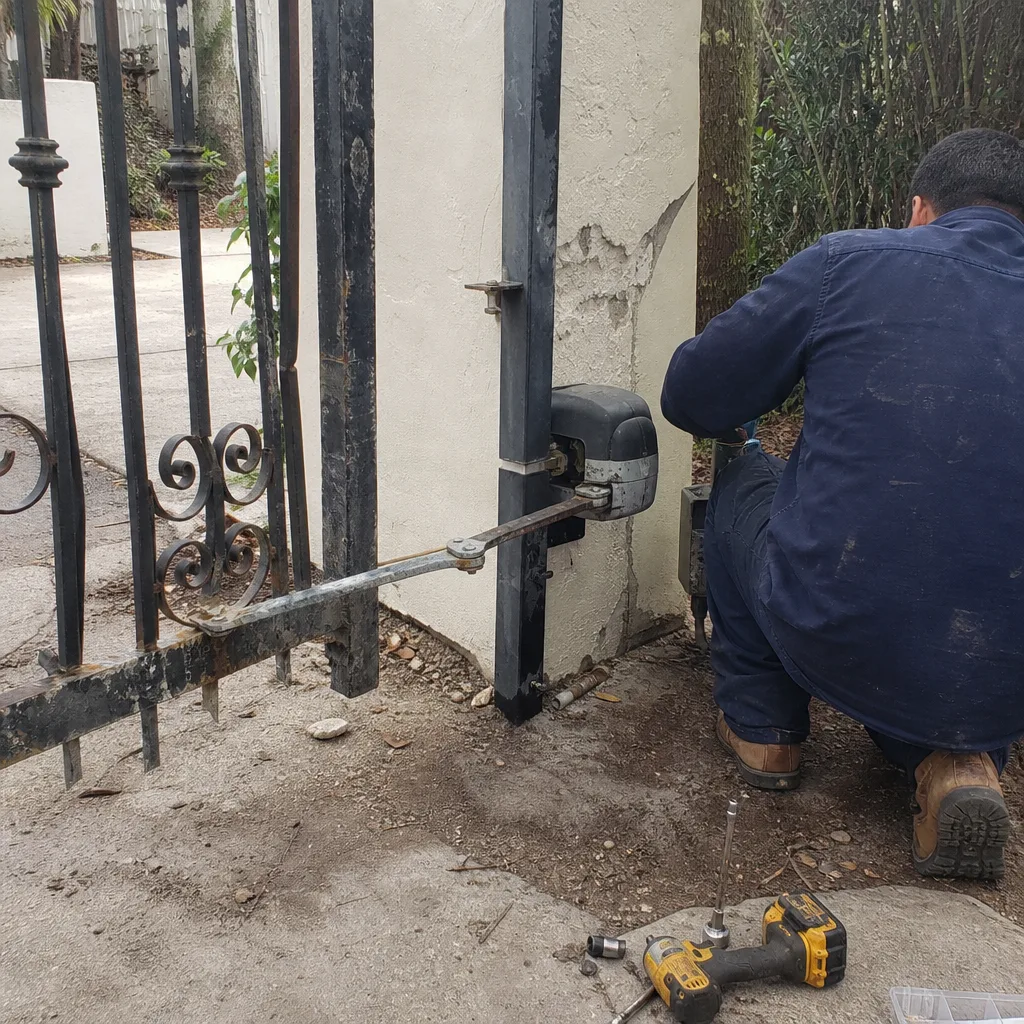 Before
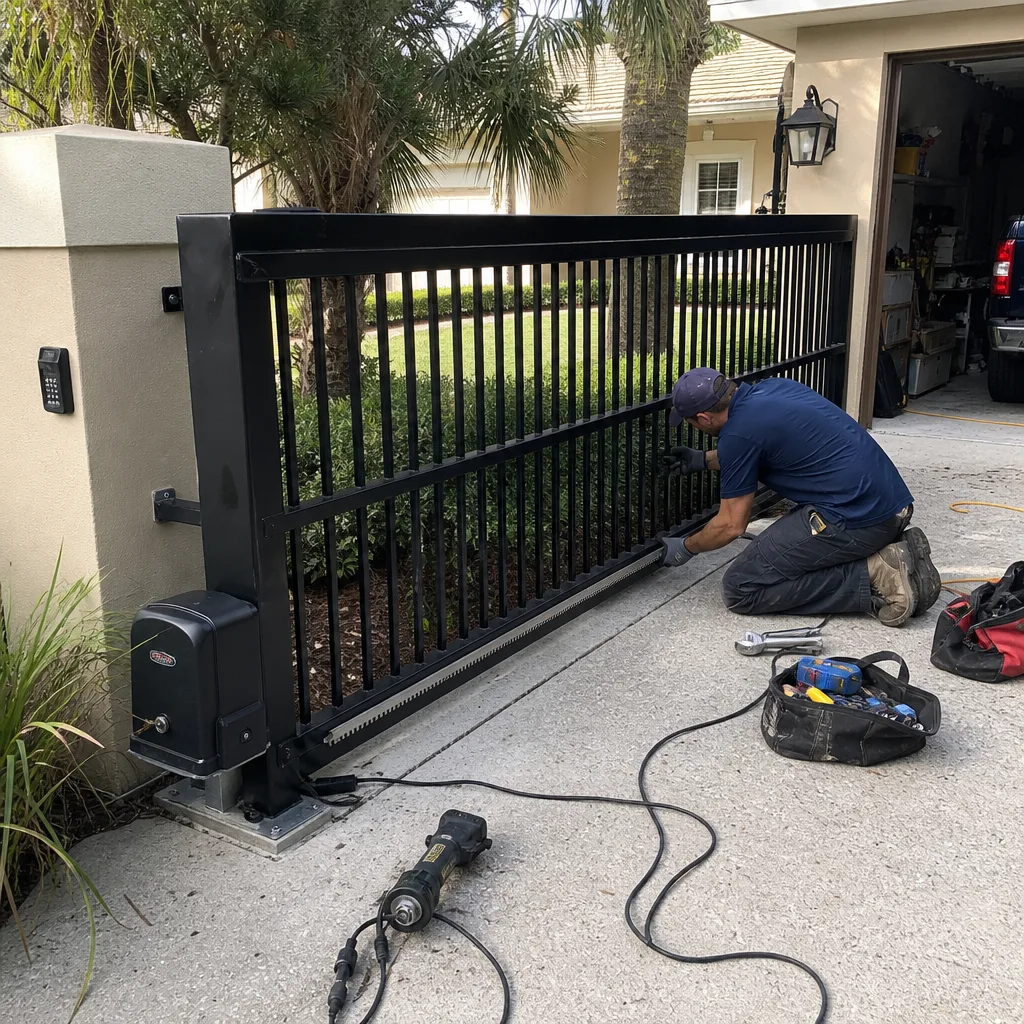 After
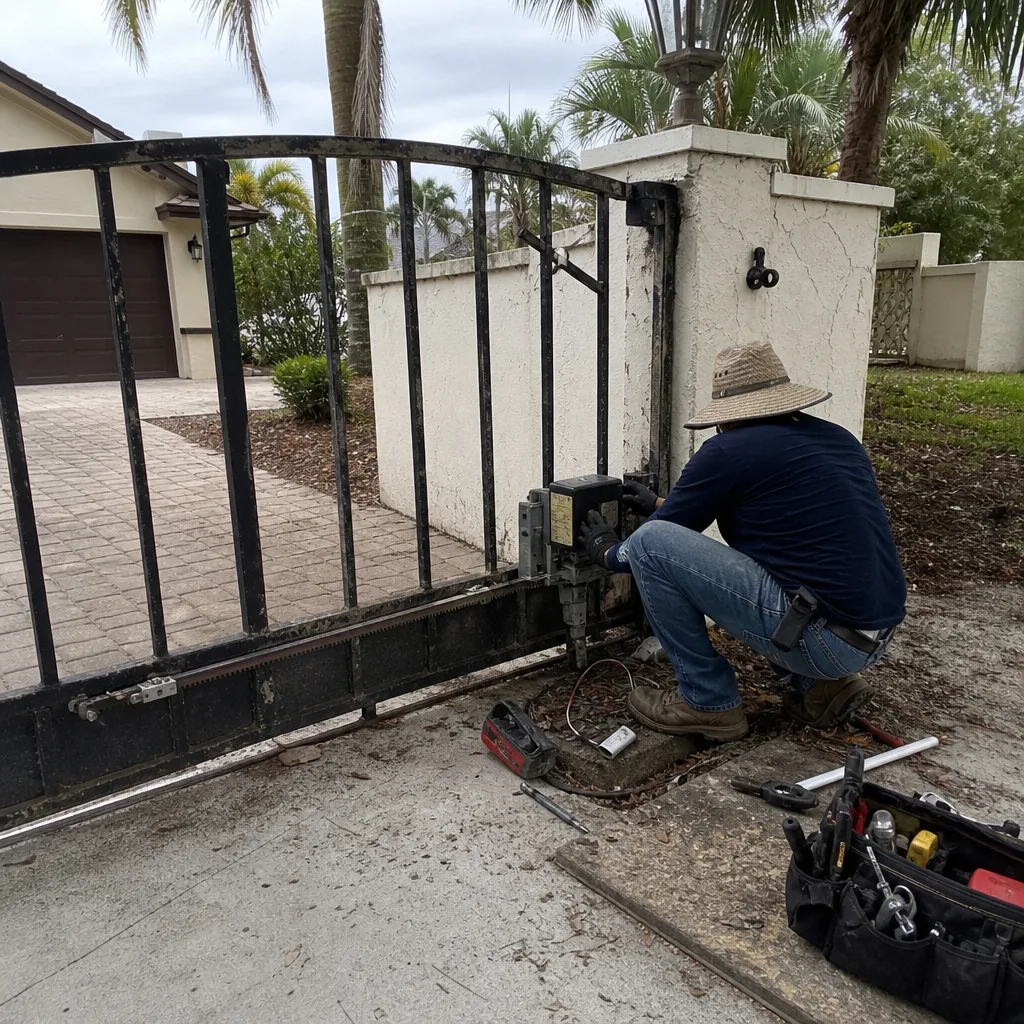 Before
 After
 Before
 After